

It occurred to me to call what I keep finding at these conferences a school without a campus: it has no classroom and no building of its own, it is assembled every year in a different city, and you learn it by walking, from Dubai to London, Mexico City, Hong Kong and, in a few days, Cairo. The “modern” architecture we all studied and fell in love with took over the world with universal truths, then branched into paths as varied as the cities of the world and, by dint of repeating itself, began to flatten cultures and lose authenticity. Today, in every country and place I travel to, I see a movement that values local culture (some people never stopped doing it). There is a new international school there: a new international architecture that wants nothing less than to be international, one that seeks for each place to value its own culture, its materials and its own history. For me, the AIA International conferences are an excellent place to watch it emerge and to listen to great masters of that search. If in Pathos 01 I asked whether there is an Argentine school, here the question turns around, or is reframed: is there a new international school that is precisely opposed to being one?
A few days before travelling to the AIA conference in Cairo, I thought it was a good moment to share a little of my path through that institution. I can already tell you that one of my next Pathos will be about nothing more and nothing less than Egypt… and its new modern city? How strange that sounds… It will probably be Pathos 05, unless another topic gets there first, since I always have several on my mind; if not, it will be Pathos 06. Here it is AIA. American International Airlines… Having made the silly, simple joke, let me correct myself: the American Institute of Architects.
Disclosure: I am Country Representative for Argentina, AIA International (the AIA is the American Institute of Architects). I write in a personal capacity: what follows is my opinion and does not speak for the AIA.
There is no better way to learn architecture than by walking through spaces. All of us who studied or practice architecture get a kind of extra pleasure out of every trip, every walk through a new city, or through our own. We develop a sort of sixth sense: feeling the route, the movement of our body through a space. Mind you, everyone has it: it would be too obvious, too much of a cliché of the architect’s ego, to see ourselves as superior… even though we are. I am not saying architects have it and others don’t, only that we train ourselves to know why we feel what we feel in a space, a building or a place. Architecture is a superior art and, therefore, we are superior. Well, it’s a joke… but not really. At least I confirm my passion for walking routes every time I travel.
That is why I go to the AIA’s international conferences whenever I can. I recommend them to any colleague who has the chance, and above all the ones held outside the United States. It is the recommendation of someone who practices mainly outside that country and who came back from each one with something he did not have when he left.
In 2020 I lived an incredible moment in my career. In the middle of the pandemic, on the recommendation of a great friend, excellent professional and university classmate, Marco Praga, I had a Zoom interview with José Luis Salinas Ollé, Country Representative of AIA International for Costa Rica, Honorary Fellow of the AIA (Hon. FAIA) since 2017, an AIA member for more than 20 years and one of the driving forces, if not the driving force, behind the Latin America group. I will always be grateful to them both.
Besides being an outstanding architect, a pioneer of real-estate development in his country and a member, on several occasions, of the board of directors of the Costa Rican Chamber of Construction (Cámara Costarricense de la Construcción), José Luis is, above all, a great person and a mentor to me. His career is incredible, but his person and his passion for what we do surpass it. After the interview he offered me the role of Argentina’s representative to AIA International, and of course I accepted… without being very aware of how incredible what had happened to me was… until Dubai, in 2021, my first AIA international conference. To top it off, it coincided with Expo 2020 Dubai, the world’s fair that the pandemic pushed back a year and that ran from October 1, 2021 to March 31, 2022, on a 438-hectare site, with 192 participating countries.
The city was full of unique pavilions built for the occasion, and today the site is still in use as Expo City Dubai. I had been to Dubai twice before, and I will talk about the Emirates in another Pathos, but I watched it grow. In my memory, the elevated train ended in the middle of the desert, and that year it reached the fair city: the “Route 2020” metro extension, 15 kilometers long, from Jebel Ali to the Expo 2020 station. Another clear example of how walking a place teaches you in a unique way, and not just once, but by returning to cities after a couple of years and seeing how they mutate, expand, grow or gentrify. Thank you, José Luis, I am eternally grateful. It is an honor to be part of the AIA.
Walking is not looking
A photo, a plan or a render shows you a building. Walking through it is something else: it is architecture in motion, it is a route, it is a multisensory experience; it may sound a bit corny… but that is literally what it is. Walking a building tells you a story, it tells you how it receives you: what you feel when you enter, whether you feel squeezed or breathe space, whether you are comfortable or uncomfortable. And if something makes you uncomfortable, it is worth asking whether it is a mistake or whether the building wants you to keep moving. Where there is a “living room” set up with furniture, a place to rest: is it for relaxing, or for staying a few minutes and moving on?
That is the emotional charge of a place, the one that gives Pathos its name, born of the load of things I felt and needed to say: what a situation does to the body. You read very little of a work from the outside, although you can train yourself to predict its route from little information. You understand it by walking, and a conference in a city far from home set me walking with many authors at my side.
Seeing the voices of the world
A conference like this has a virtue that no magazine and no Instagram account can replace: the authors are right in front of you, you talk with them, they tell you anecdotes, you ask them about their works or their creative processes. You don’t just see the photo of the work; you hear the person who conceived it explain what they were after, what went wrong and whom they had to convince. And afterwards, on a tour or over coffee, you can follow up on anything that interests you.
One of the loveliest things is the variety of places where the AIA International conferences are held. Because they happen far from the spaces we know best, and move between different hub cities of the world, the map turns upside down… we step out of our furrows and grow exponentially. What at home we read and studied as the periphery of our practices becomes the host. Besides, there is no better way to get to know cities than with a productive excuse, not only as tourists or passing visitors.
What interests me most is how regionalisms, those ways of building that are born of a culture, a climate, certain crafts and a history, stop being a footnote to a published work and take center stage in cities all over the world. I see more and more studios that defend, through their work, the value of the cultures where they practice. It is not folklore: a work that does not listen to the place where it stands ends up looking like any other and flattens the world even more, a world already battered enough by the era of mass production and globalization. I keep repeating myself about this in several texts, and I will probably keep repeating myself. I believe, in any case, that the soul of places always prevails.
Place and non-place
At every conference I have attended, the tendency to talk about buildings of their place has grown stronger. The idea is worth explaining, because it is used a lot and often not correctly.
The French anthropologist Marc Augé, whom I cite again and again, called “non-places” the spaces of transit we pass through without staying: airports, highways, big hotel chains, certain shopping centers. They work, but nobody is from anywhere, there is no history to read and no relationships being woven. A place, on the other hand, is the opposite: it has memory, identity and people who recognize it as their own. The question these conferences ask is what makes a building belong to its place rather than be an object that could stand in any city. It is the same question I asked in Pathos 02, when I wrote about museums: some museums seem to grow out of the place where they stand, and others land on it. Of the Lucas Museum in Los Angeles, I said I read it as a museum that landed on the city, and of the Louvre Abu Dhabi, that it understood what the site was made of.
A journey, in order
Dubai (November 11 to 14, 2021) was the first conference I attended. It coincided with the world’s fair, Expo 2020, and I went alone. The conference was held at Concrete, designed by OMA, in Alserkal Avenue, a very interesting multi-use center a few stations from downtown. From there we would ride daily to different buildings and to the Expo. Among the works I saw was the Bahrain Pavilion, by Christian Kerez, which I walked through with his local partner in charge of the construction, who shared many details about how they assembled its unique structure. Then I toured the inside of the UAE Pavilion by Santiago Calatrava, which I found incredible, and which triggered a thought: it could be anywhere in the world, a kind of non-place. We country representatives went through the pavilions with members of the architects’ teams, who explained the concepts themselves. The World Expo surprised me so much that I promised myself I would go to every one from then on. And yet I missed Osaka, in 2025.
It is true that the pavilions at this fair are a world of their own, and while some are more successful than others at representing their country, they feel more like an amusement park for architects than buildings of a place… but that fair is a world of its own. I will try to go to more of them to dig deeper into this. For me it was a double impact, my first AIA conference and the world’s fair, which put me in an intellectual “doble nelson” (Argentine slang, after the wrestling hold: it knocked me out intellectually, in a good way).
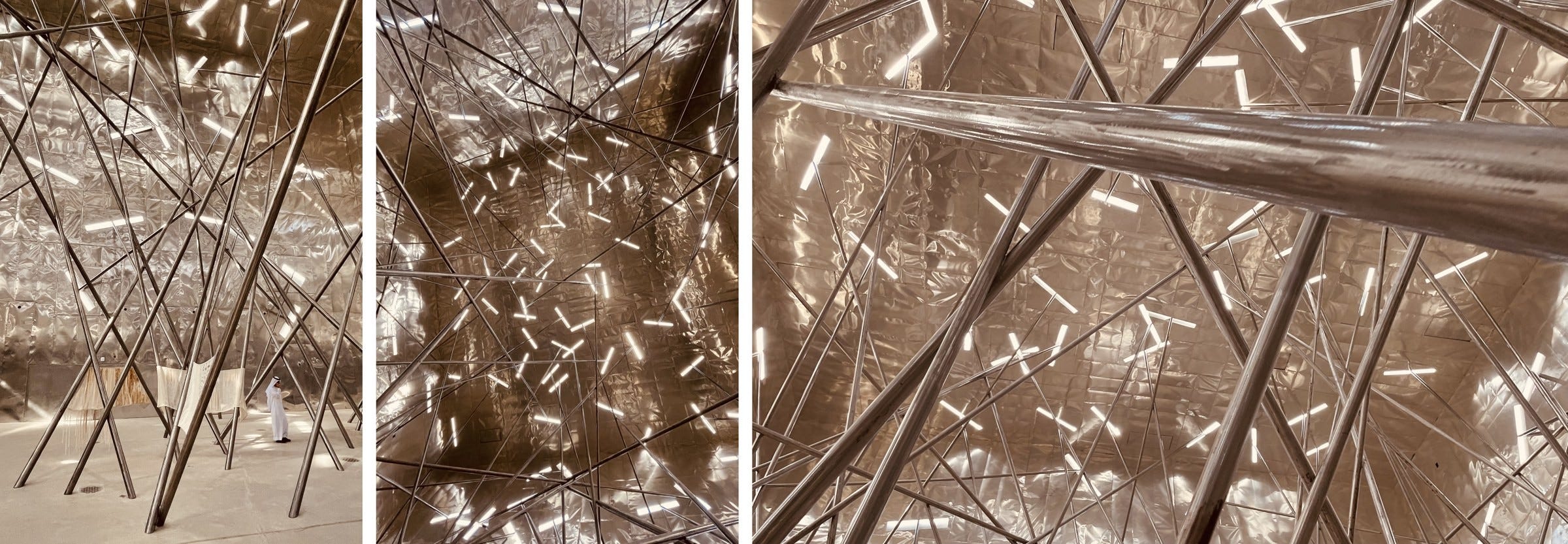
You walk in and the leaning columns force you to decide which way to go. There is no marked path: every step changes what you see, and between the gleam of the metal and the lights you feel you are passing through a material rather than a room.
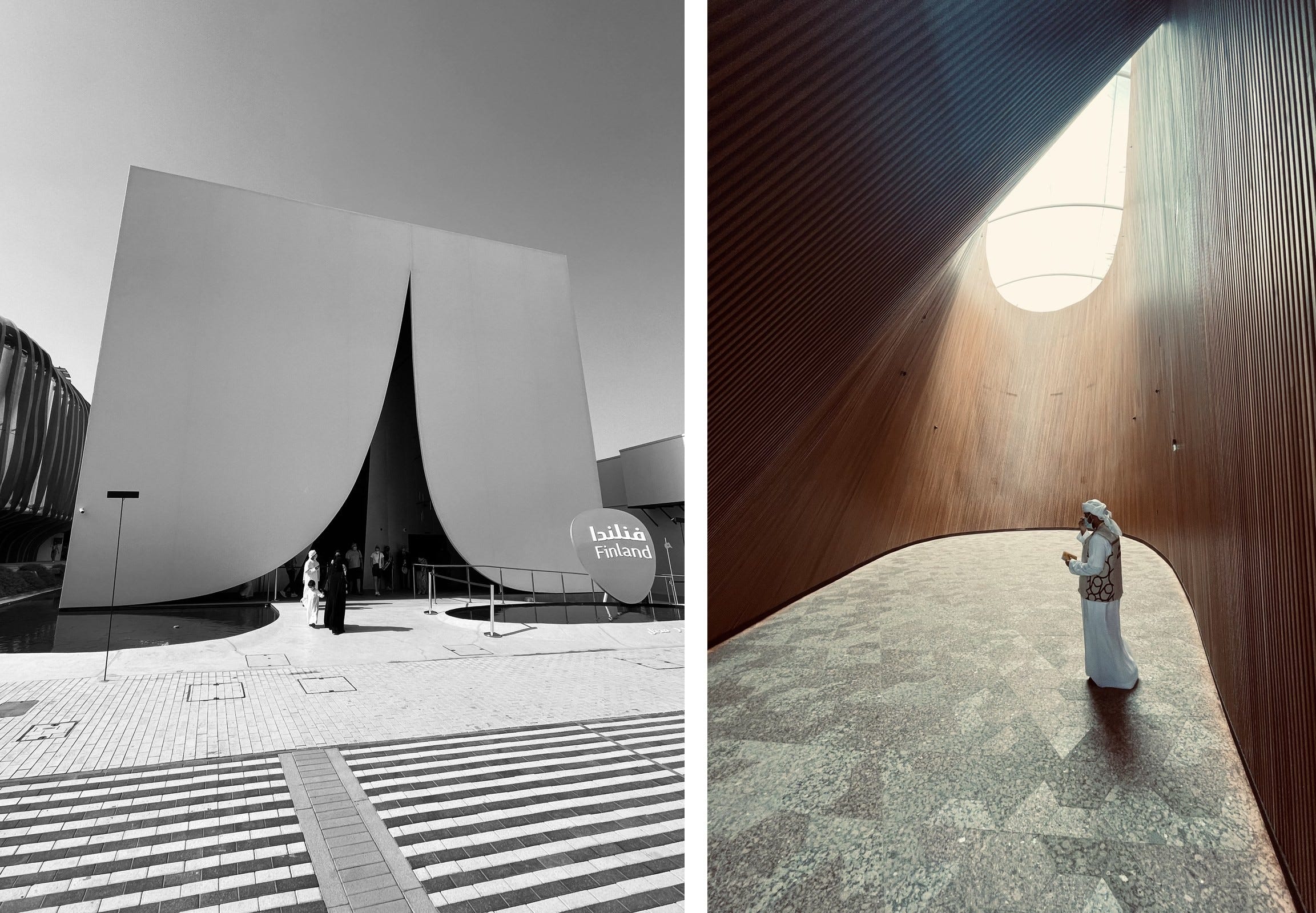
A wooden passage that curves upward and opens to the light at a single point. It is the kind of space where the body understands where to go without a sign or an arrow.
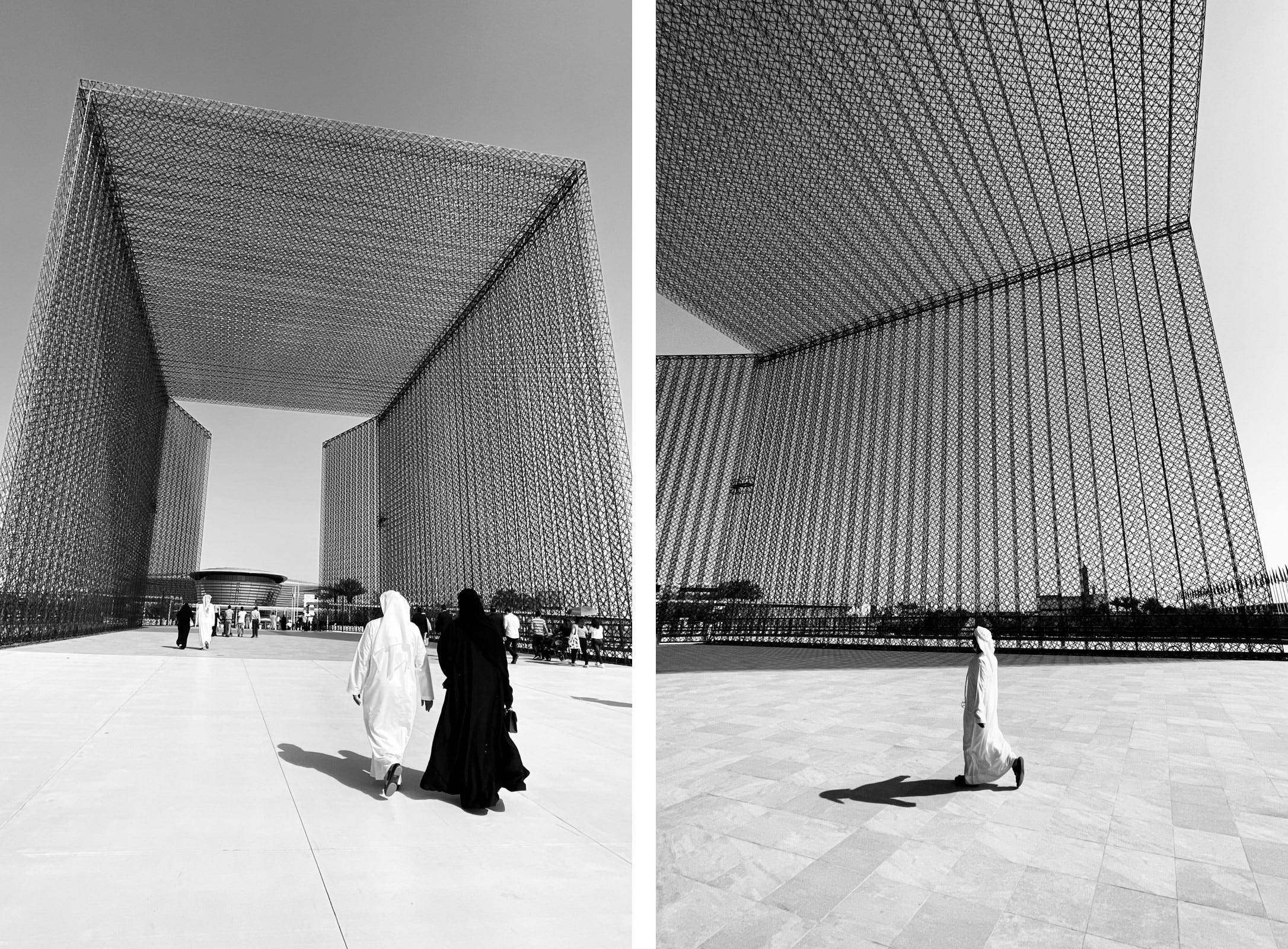
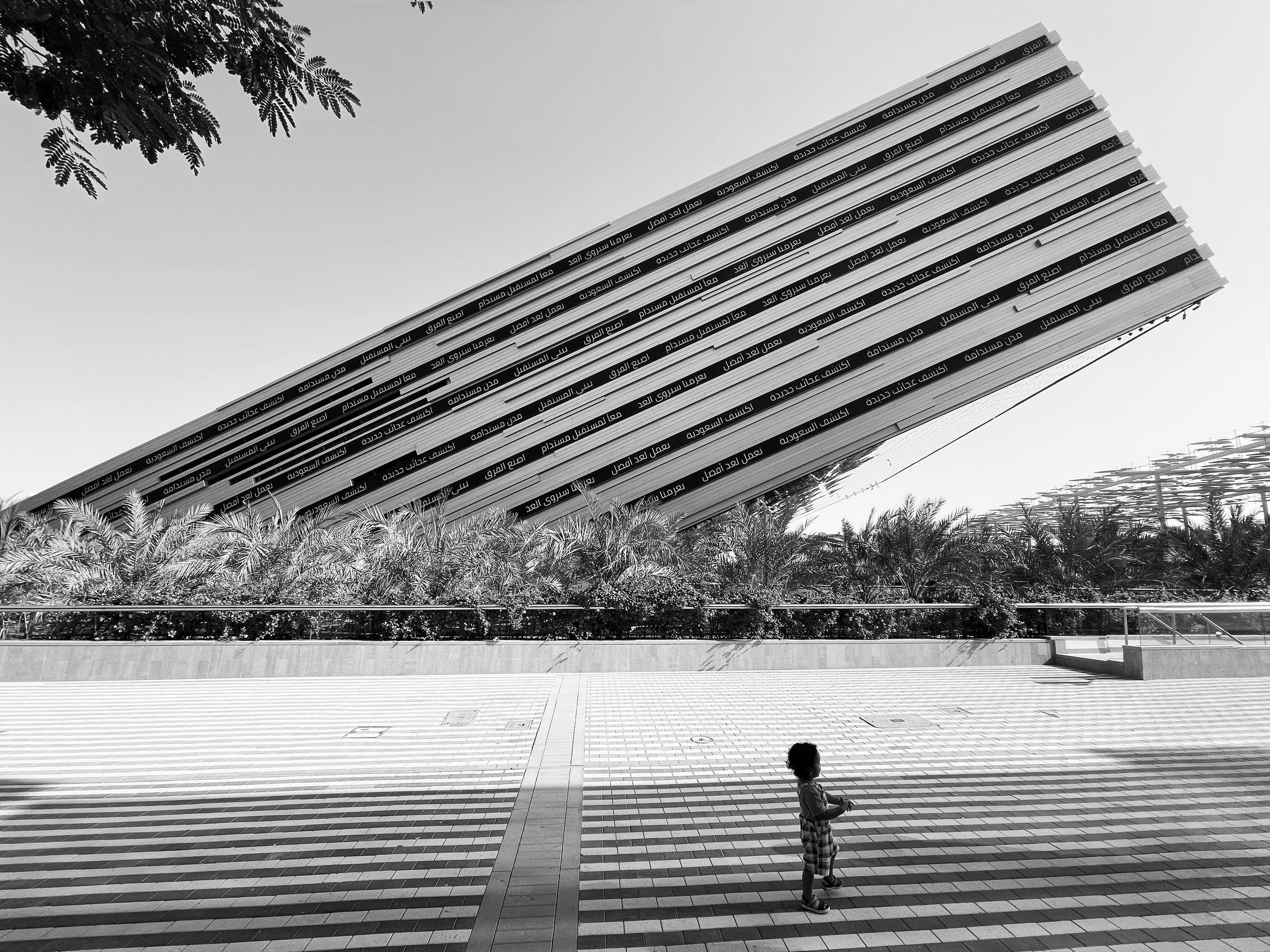
A mesh skin that filters the light and a single figure crossing. At that scale the person becomes the measure of the space, and their shadow on the floor, part of the architecture. This is a work that is international and local at once; it shows the vision and ambition of this city… it seems designed for an eternal sun.
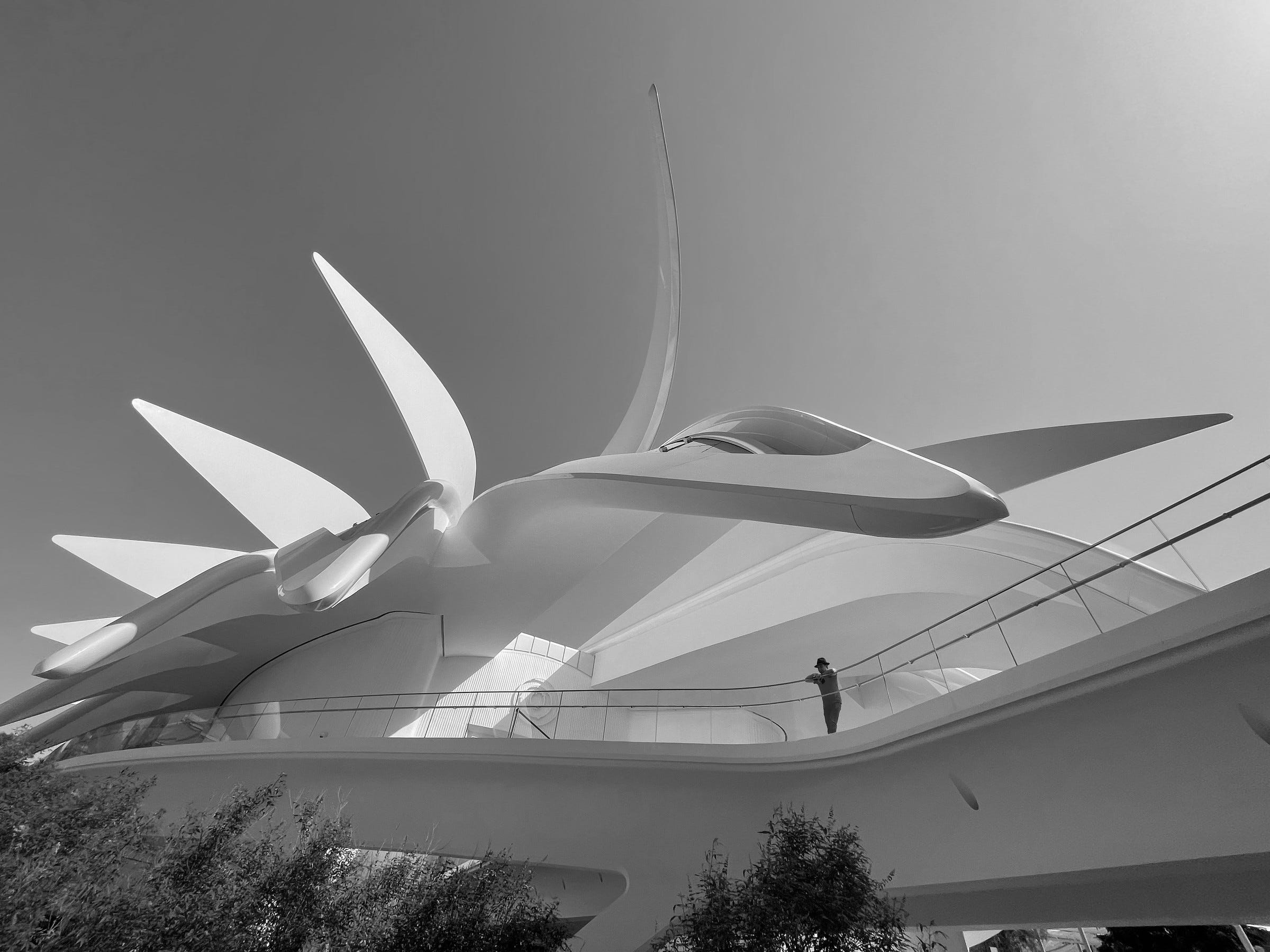
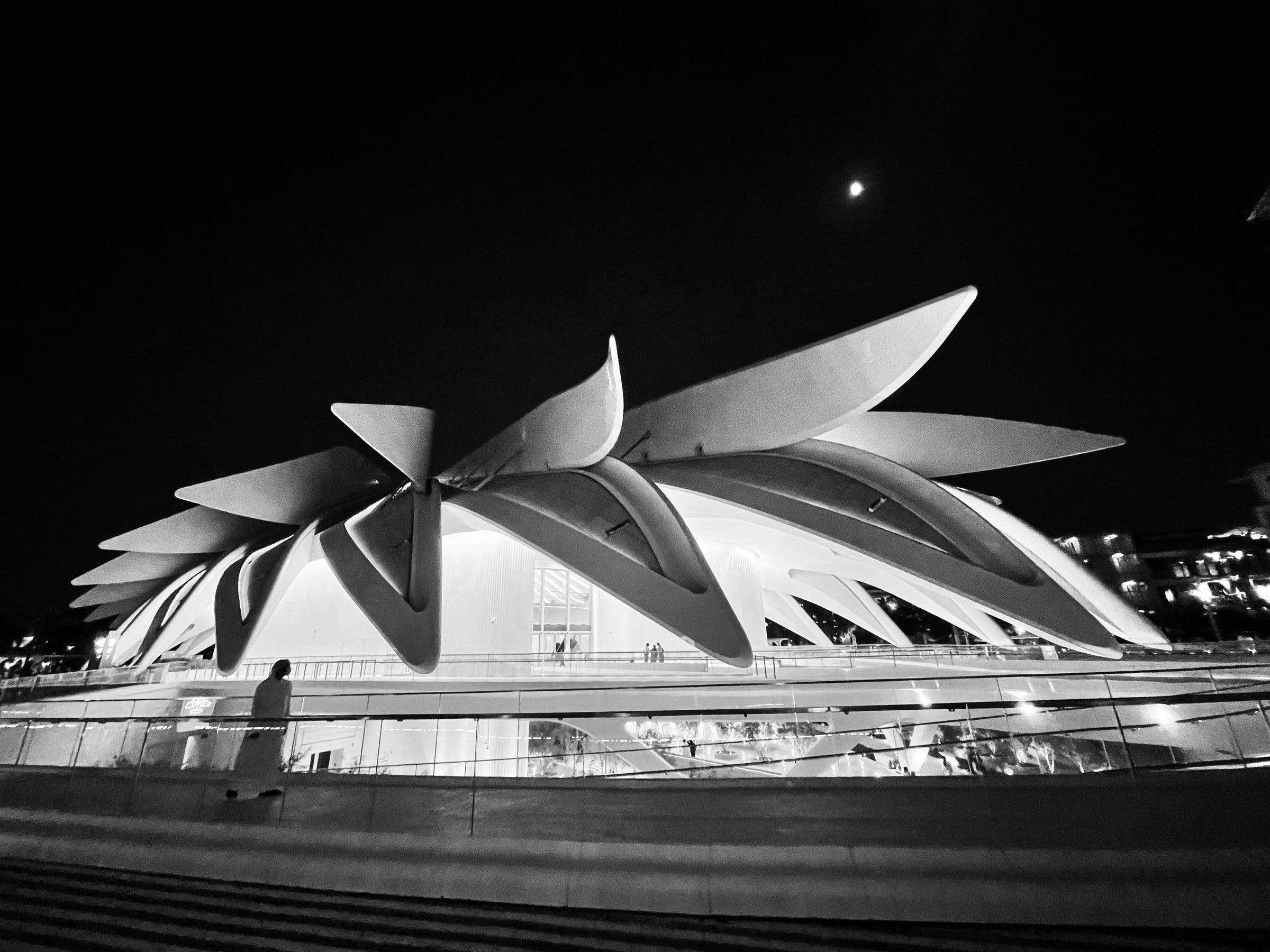
Note: I wanted them in black and white to give them an old-school futuristic air, like a modern version of Fritz Lang’s Metropolis. Calatrava, a genius.
At night the pavilion changes character: what by day is a light structure becomes a floating silhouette. It is what I said at the start: the same work walked at another hour is another experience.
London (September 29 to October 3, 2022) left me Phil Coffey’s work at 22 Handyside Street, which I visited and photographed. I found it spectacular. Coffey, who comes from photography, presented that work at the conference, and I identified with him right away. At the closing party we talked about our passion for photography… about how studying photography gives a lot of perspective to the practice of architecture.


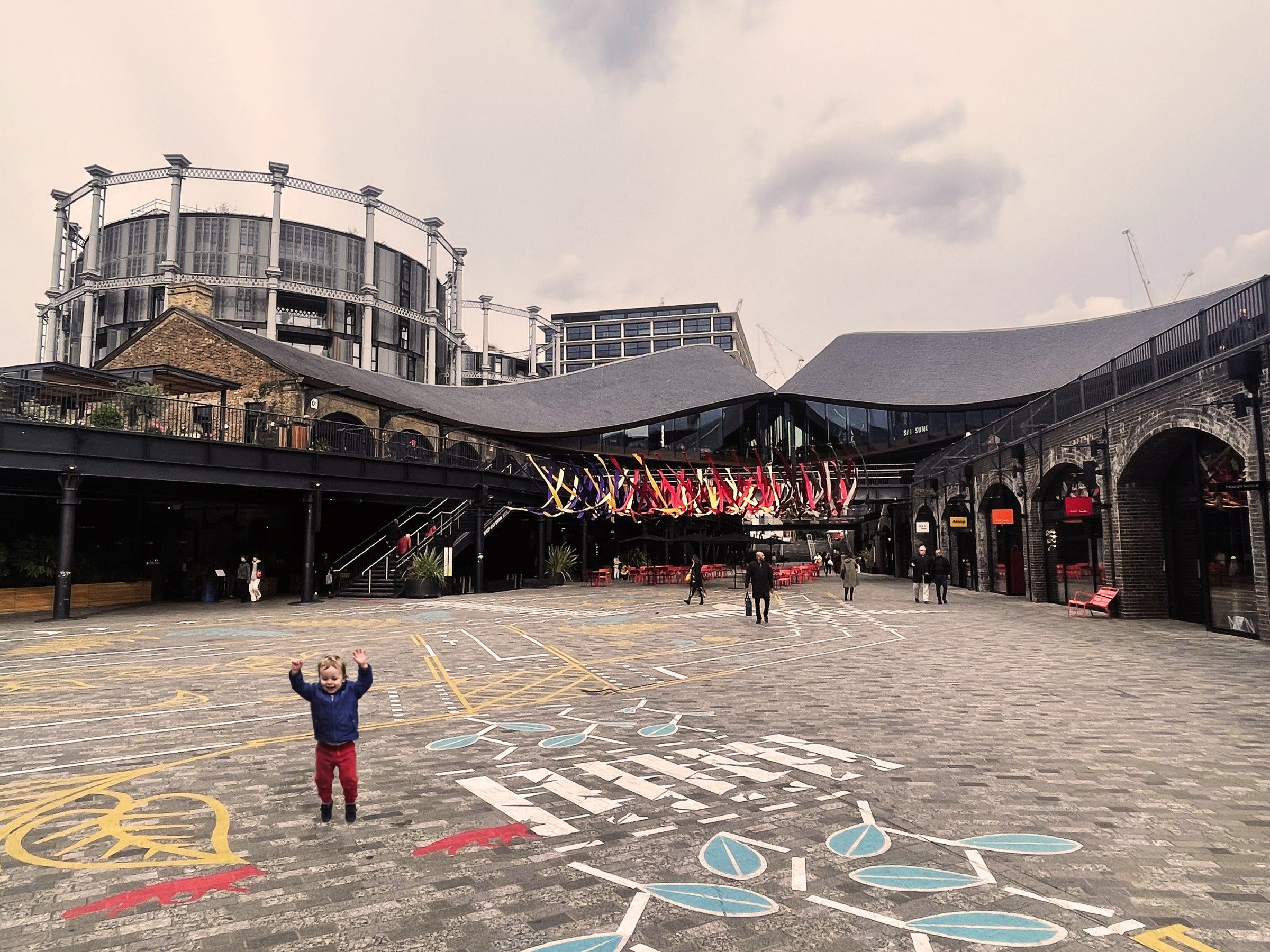
One of the London conference venues was Coal Drops Yard, in King’s Cross: a former coal yard, recycled, on a square. It is part of a very interesting masterplan, King’s Cross, developed by Argent and masterplanned by Allies and Morrison and Porphyrios Associates, with buildings by David Chipperfield (One Pancras Square), Heatherwick Studio (Coal Drops Yard itself), WilkinsonEyre and Bell Phillips, among many others. The recycled gasholders you see in the photo, now homes, are a clear example of this new architecture that, being international, refuses to be. It values a place, draws on its history and builds a city rooted in the way the place has evolved. A true Place. International architecture that shines by not being international.
A facade that reads like a fabric: the material works with daylight and changes with whoever walks past. It is worth more for what it does on the street than for what you see in the photo.
From the corner the facade becomes a pattern of panels that changes with the angle, and the passing figure gives it scale. The work is understood in motion, not from a fixed point. I have no photos of the interior, but I was struck by how the inspiration for this facade was the light it creates inside, inspired by the way light passes through the leaves of trees, and not the aesthetic result of the facade itself, although what is interesting about it is plain to see. He shared his search as a photographer through this observation, and from there moved on to researching the facade of this building.
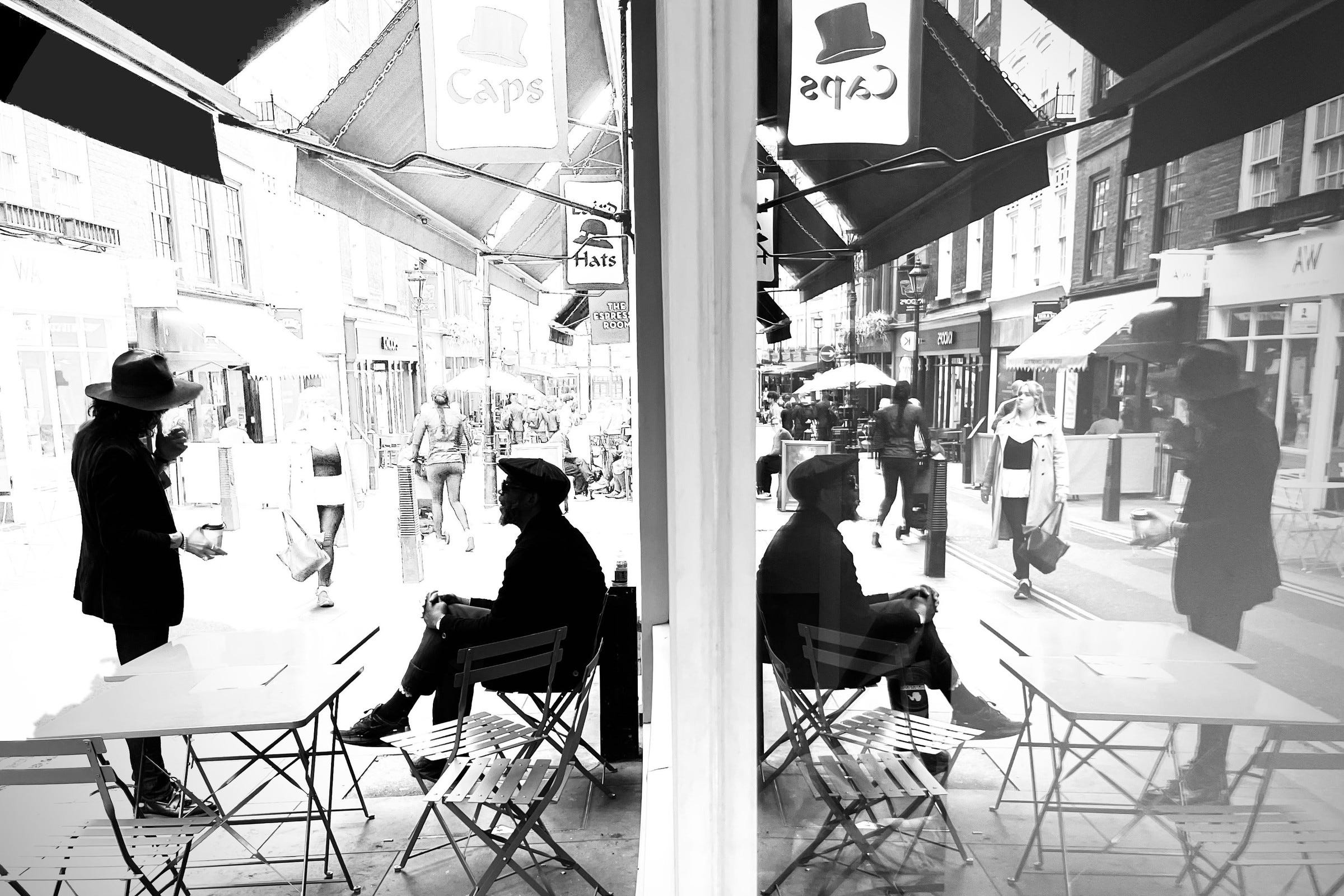
I chose it as a nod to the informal conversations that happen around the conference: on the street, in a café, on the way to the next talk.
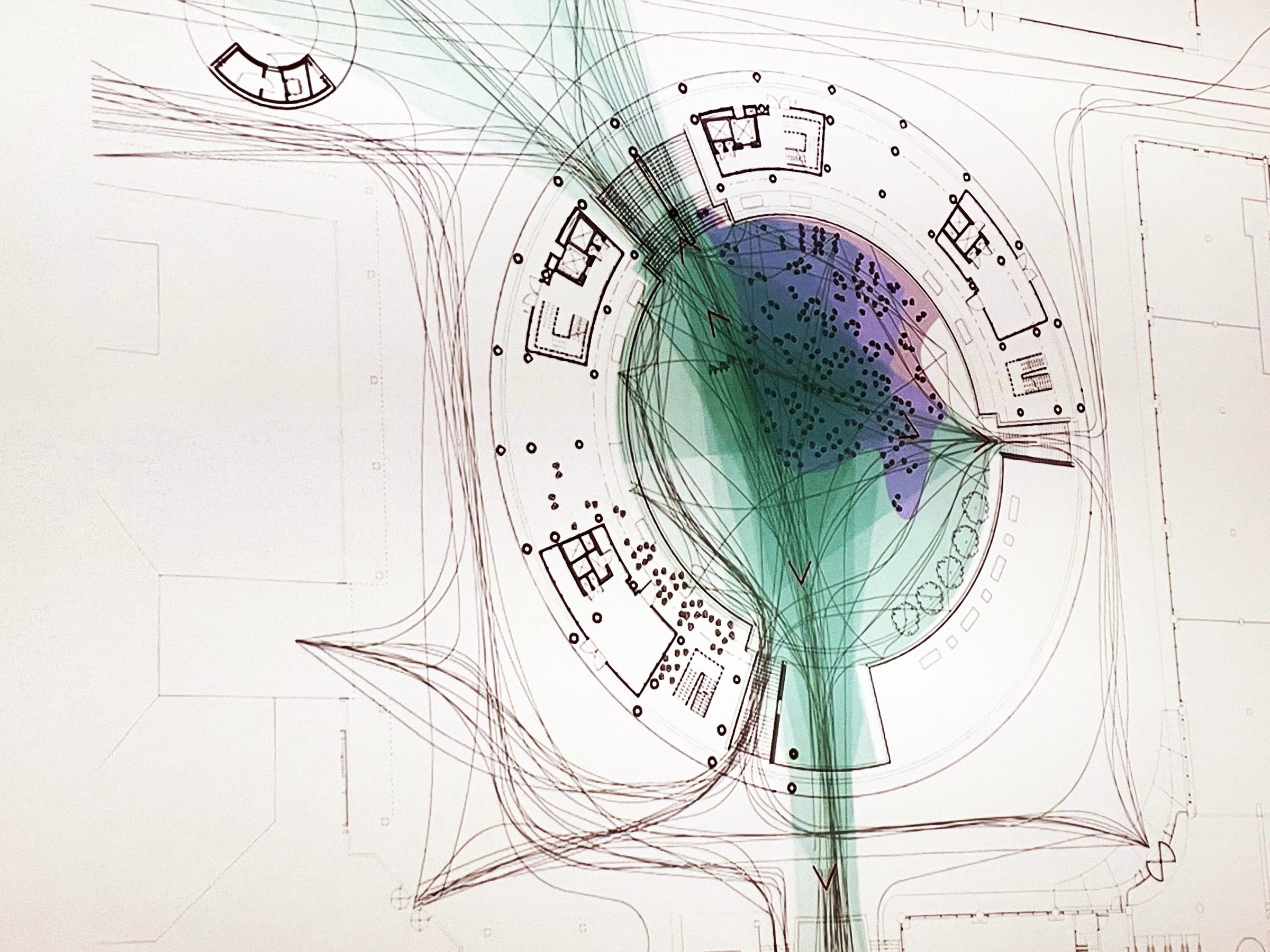
That conference left me with something else, which has to do with walking. On October 2, 2022, I heard the architect Deborah Saunt, of DSDHA, talk about her public-space work at Broadgate, in the City of London; the talk was titled “Exchange Square”. I tell it as I remember it, from memory: they used security camera footage to study the flow of people and the routes across a square between buildings, and they placed the resting spots based on those flows. I found it practical, useful and creative for designing urban spaces in an established fabric. It is an architecture at the service of how things already work, in a complex fabric loaded with history, and not one that invades and arrogantly changes the use, clashing with the natural flow, especially in a circulation hub crossed in several directions.
Mexico City (November 2 to 6, 2023): on Sunday the 5th I spent the morning walking with some colleagues through the Vasconcelos Library, by Alberto Kalach, and the Historic Center, mostly talking and sharing thoughts alongside someone whose identity I did not know. In the afternoon we went to the conference, and there it turned out he was Jacob van Rijs, of MVRDV, one of the speakers. Backstage, before the talk, I said something like “Oh, so you’re you? I love your work”, and we started laughing. Then he gave a great, very inspiring talk. So thank you, Jacob.
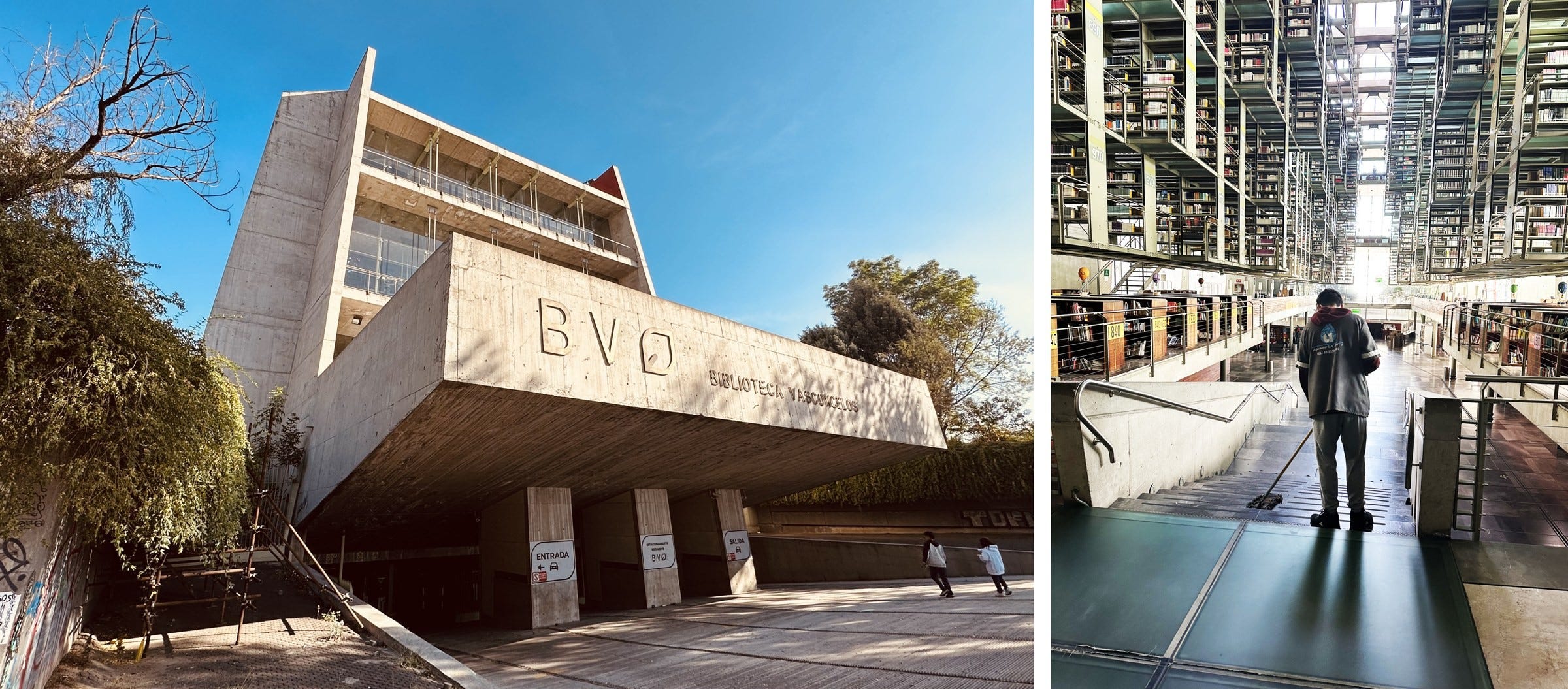
The cantilevered concrete greets you before you enter, and the scale of the volume rules over everything else. It is a work that asks to be walked through, not just looked at.
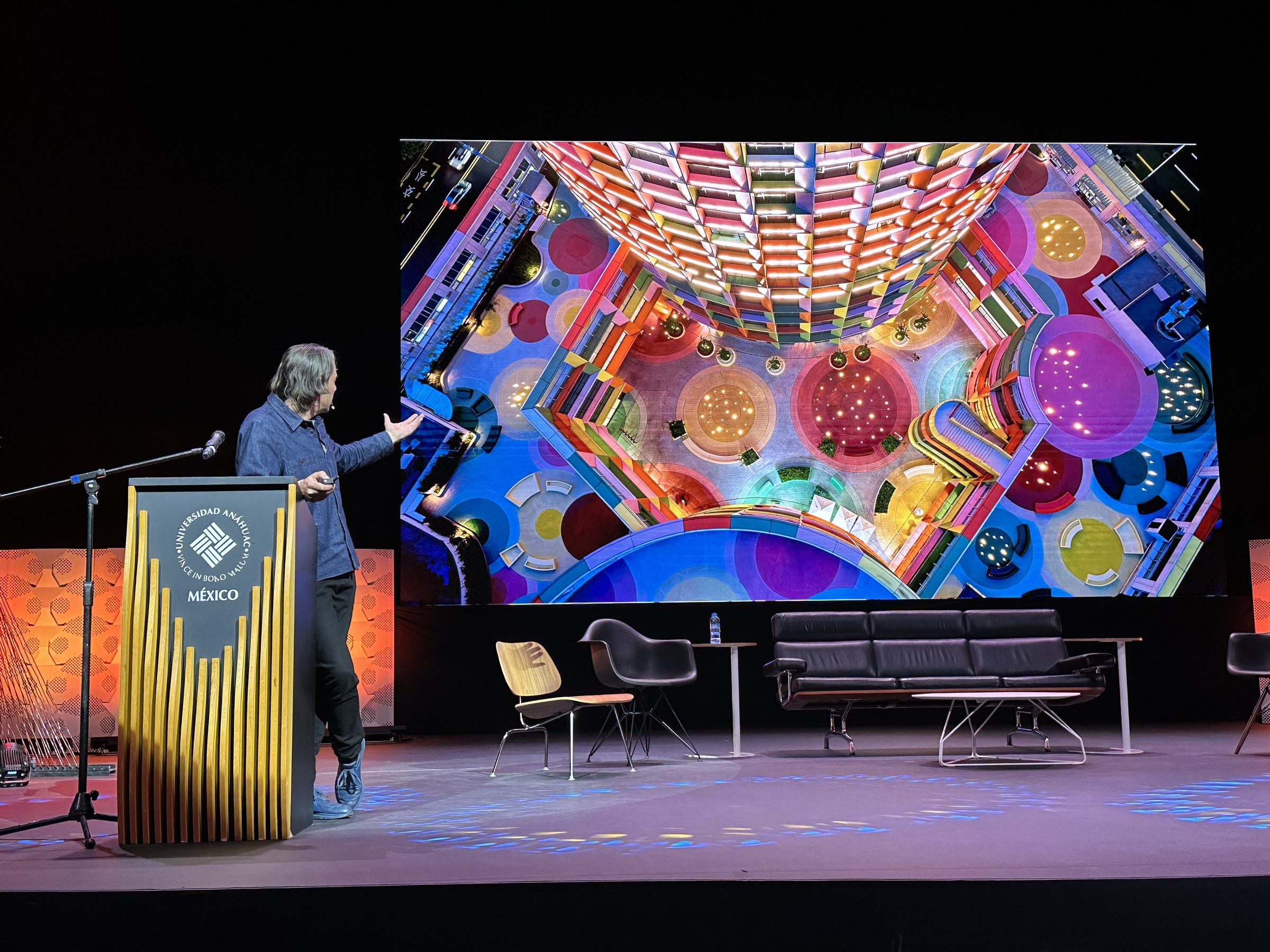
A very inspiring talk, with a screen full of color behind him. It reminded me that architecture can be joyful and effective without ceasing to be serious… It sounds contradictory, but there is a lot of playfulness in his office’s work.
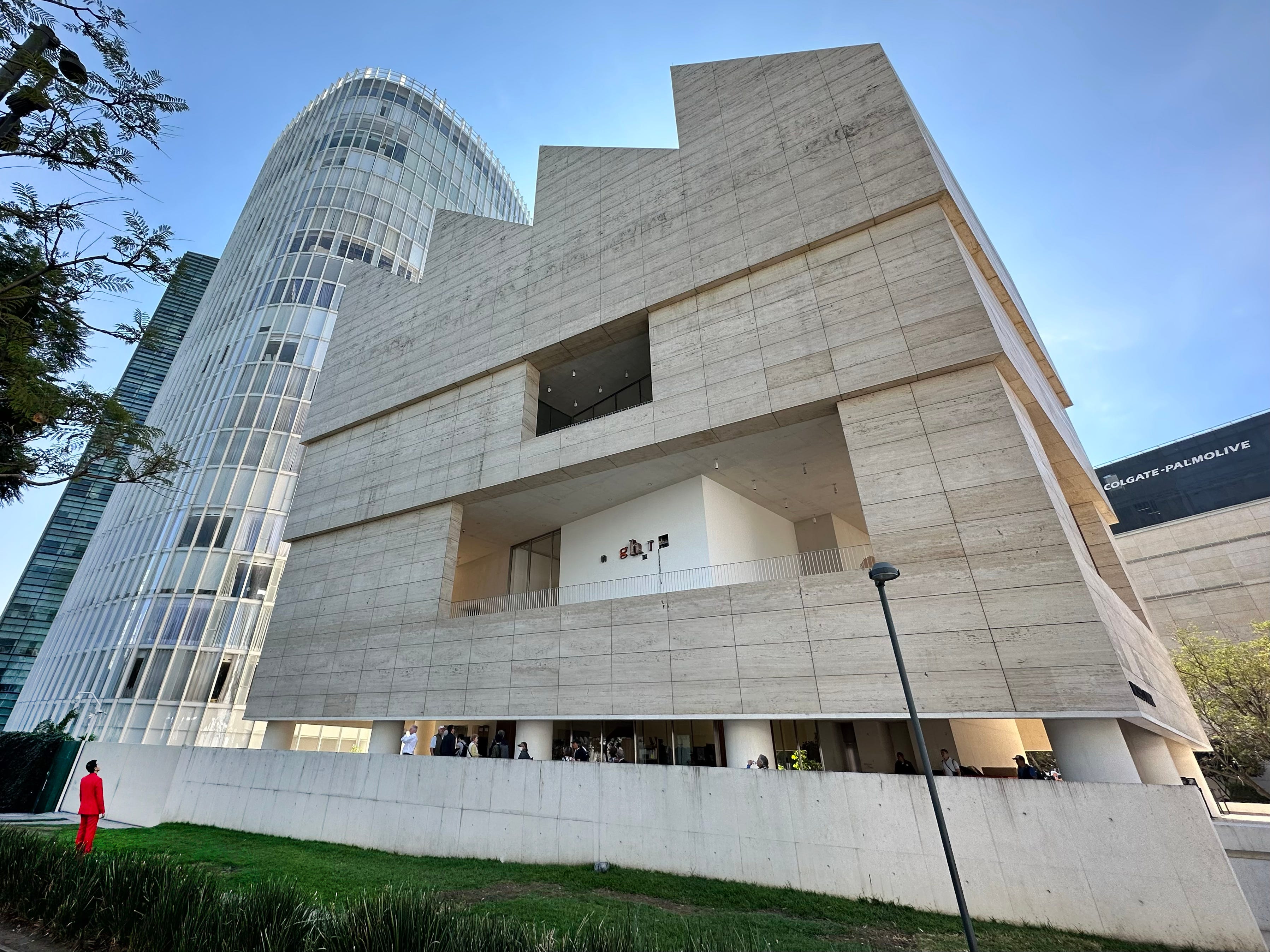
I recommend walking around Nuevo Polanco, which has several interesting buildings, but I want to single out this museum by Chipperfield. The whole development recycled an old industrial zone, and Chipperfield shaped his volume to honor the history of the place.


The Soumaya has a very interesting shape from the outside, but the interior route leaves much to be desired: it is too conditioned by the form, and the works are displayed without good light, in poorly resolved rooms.
I met Marcio Kogan backstage before his talk, and that was another highlight of the conference. As AIA International Country Representative I was in the back room (it was a conference with a huge crowd), so we got to share time directly with the speakers. We spoke little, and about film, not architecture, but every exchange was very rich: he is one of those universal artists who are centered on sharing a vision. Besides his work, he showed his short films, which I had not seen or heard of before, and I thought: OK, now I see another reason for his success. It made me think about how much parallel pursuits, like film, photography or drawing, enrich architecture. And the prominence of the Latin American scene was clear.
Hong Kong (October 23 to 27, 2024) was incredible. I talked with Oren Tatcher, principal of OTC, a consultancy for airport and terminal planning and design, who on October 24 gave the talk “Hong Kong International Airport Terminal Design: Always Planning Ahead”. I remember him talking about other remarkable projects his consultancy had been part of, and above all about how they planned for change.
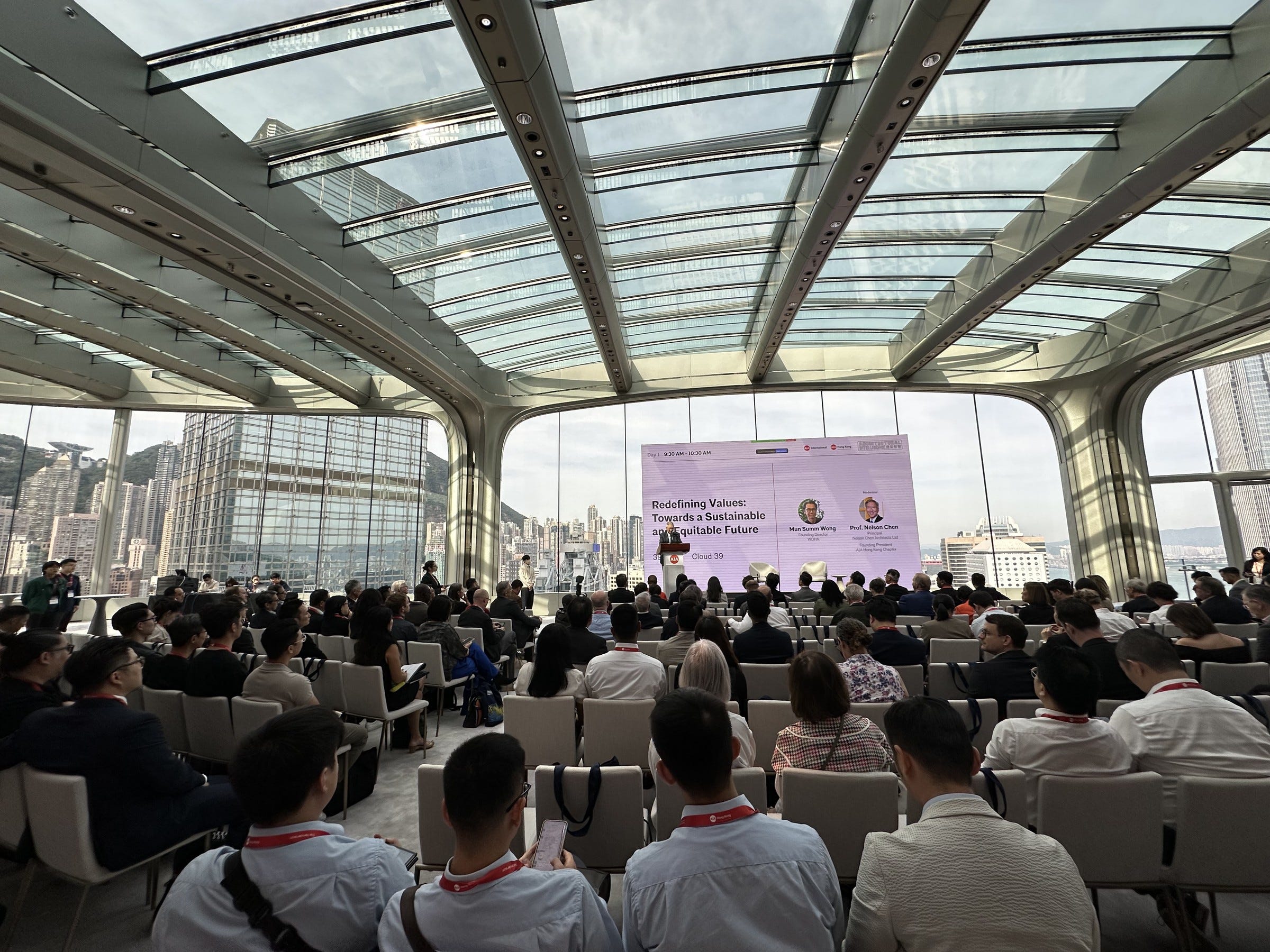
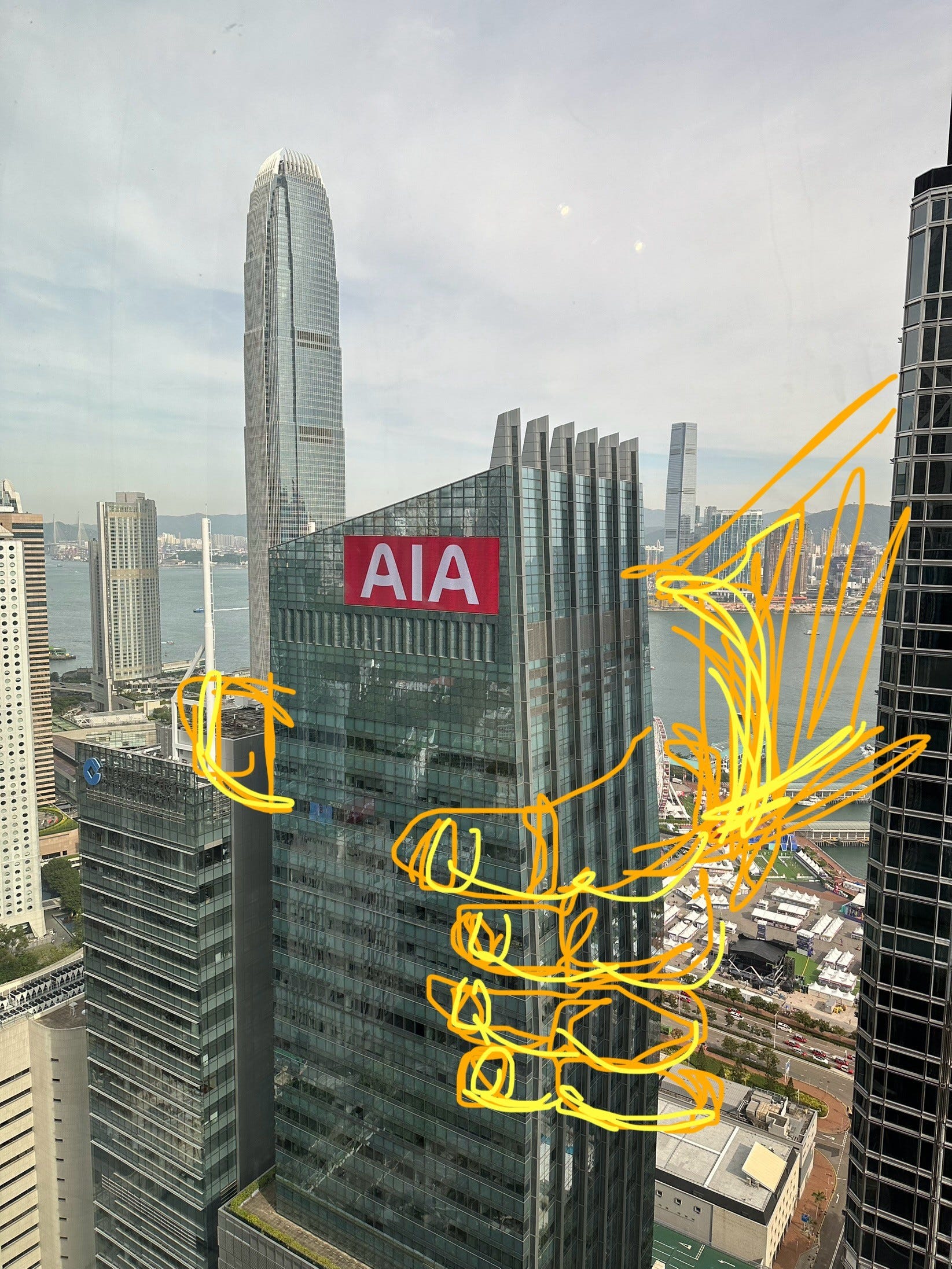
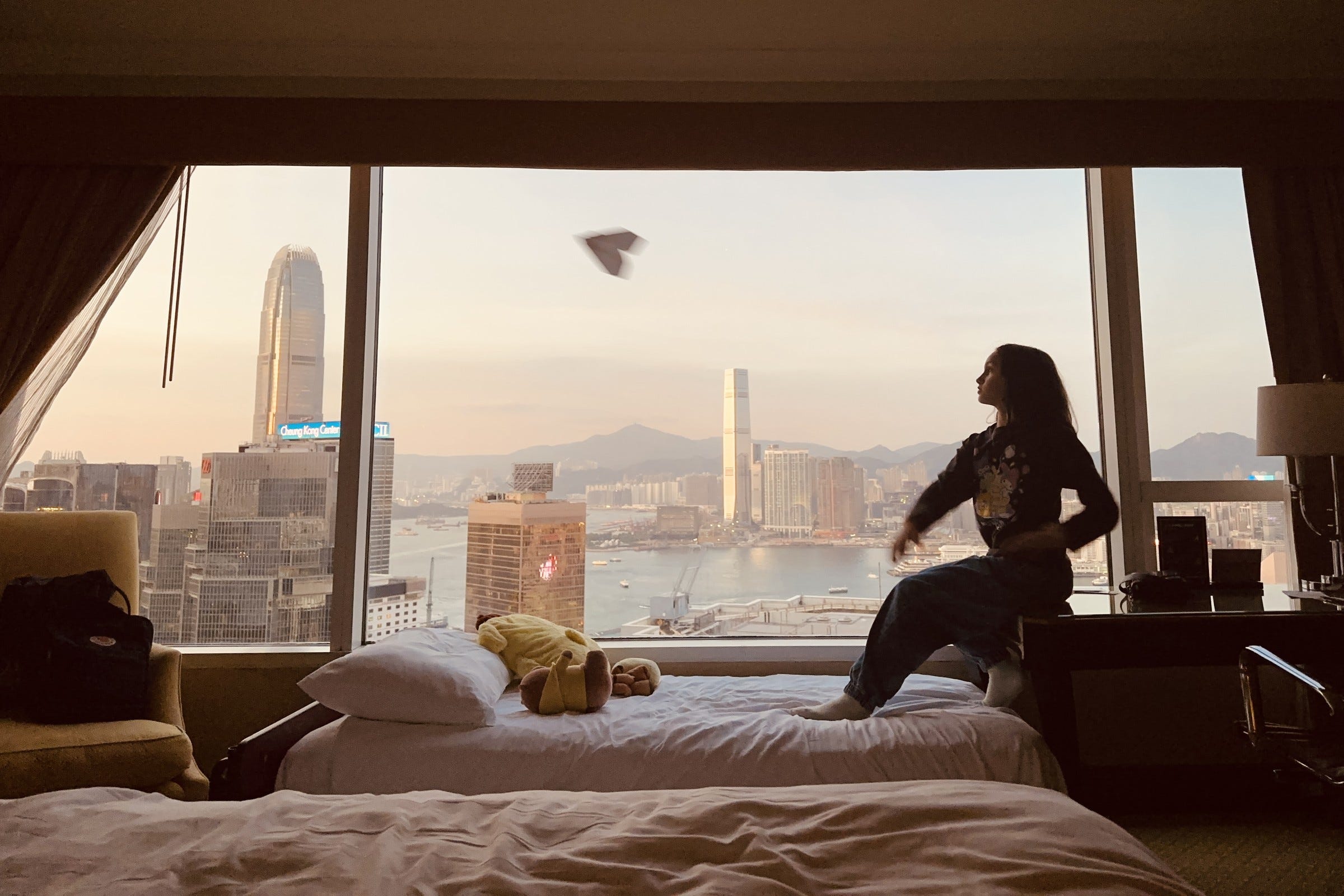
Glass towers pressed against the water. I drew over it because sometimes the way to understand a place is to draw it, even if just doodling around. The AIA sign on that building has nothing to do with the AIA, but it was very curious to have it right in the foreground from the top floor of the building where the conference was held: an incredible, fully glazed hall with views over Hong Kong, Cloud 39, on the 39th floor of The Henderson, in Central, by Zaha Hadid Architects.
I could not go to Sri Lanka, and I understand it was very good. Cairo, on the other hand, I am going to: I already have my tickets for this year’s AIA International conference, “Layers of Civilization”, from November 11 to 14, 2026, and I will write a Pathos about it. I recommend it to anyone who can make it, even if it is far away; registration closes on November 4, and the program is on the official conference website.
Beyond the conference, I want to see Egypt’s New Administrative Capital, on the outskirts of Cairo, a modern city built from scratch in the desert. It is not among the tours in the conference’s published program, so I plan to visit on my own. A monorail connects it with Greater Cairo, in commercial service since May 2026 with 16 of its 22 stations.
A clarification to understand it: it has no single author. SOM presented the initial concept on March 13, 2015, for the Ministry of Housing and an investor group. The plan was then reworked by a consortium of five Egyptian firms, known as UDC+5, and since 2017 it has been reviewed and validated by Dar Al-Handasah. The developer is ACUD, a company created in 2016 that is not the one doing the design. According to Dar Al-Handasah, it covers about 715 square kilometers and plans for 6.5 million inhabitants by 2050. The government moved there in 2023, and its official inauguration as the seat of government was on April 2, 2024. Among its works is the Iconic Tower, by Dar Al-Handasah with Perkins&Will, about 385 meters tall according to its designers.
It fascinates me because of an idea I have had for a long time. In 1960 Kenzo Tange and his team designed “A Plan for Tokyo, 1960”, published in The Japan Architect in April 1961 (according to the translated summary in the journal Ekistics). It proposed replacing Tokyo’s radial structure with a linear civic axis over the bay, with some 5 million people living on the water, on reclaimed land or on platforms on piles, for a city it estimated would reach 15 million inhabitants within 20 years. It was never built. What follows is my reading, not that of any source: to me it recalls Tange’s dream, this time coming true in the desert. I am going with the enthusiasm of a traveler who wants to see with his body what so far he only knows from plans and images, and then tell you about it here.
The people behind the architects
These conferences are also a rare chance to learn from the clients, the companies, the financing and the engineering of the construction process, from everything that happens behind every large work. Sometimes architects, driven by the urge to build, fall into the hands of excellent investors and patrons; other times, into the hands of shady or plainly immoral investors and businessmen. Seeing these great projects presented by their creators leaves a lot to read on this front. We will talk another time about the politics and the morality of those who finance the works.
There is something else you learn in those days that almost never makes it into the magazines: the investors, the people behind the architects, matter as much as the architects. Sometimes they stop brilliant projects. The good ones help bring out the best in a project. A large work is the work of many, and looking only at the author is reading half of it. I say this from the other side too: I am part of an architecture and urban planning studio that is very involved in real estate developments.
What I take from the AIA
Being informed and growing together
Speaking in a personal capacity, I think the way these conferences are organized is excellent, and there is also a lot to learn from their online structure, although my participation is mainly in the conferences.
My opinion is simple. At a time when all information is a click away, what you cannot get on a screen is exposure: putting yourself in a room, hearing people who think differently, walking a city with those who build it, doubting what you believed. We grow much more together than alone, and these conferences are one of the richest ways I know to do it.
If you can, go, whether to the ones in the United States or the international ones. And tell us afterwards what you saw, or whom you would have liked to hear. I also invite you to take part in the competitions that are constantly announced, which give many young studios the chance to share their searches.
Here are some of the sources I consulted while writing this piece, in case anyone wants to look more closely:
Sources
Marc Augé, Non-lieux. Introduction à une anthropologie de la surmodernité (Seuil, 1992); in English, Non-Places: Introduction to an Anthropology of Supermodernity (Verso, 1995); in Spanish, Los «no lugares». Espacios del anonimato (Gedisa, 1993): https://www.seuil.com/ouvrage/non-lieux-marc-auge/9782020125260
Pathos 02, “Disappearing to Be Seen” (Lucas Museum, Louvre Abu Dhabi): https://www.pathospractice.com/p/disappearing-to-be-seen
Official AIA International programs: Dubai 2021 https://www.aiainternational.org/2021-annual-conference-program (UAE Pavilion tour with Calatrava International, 11/13) · London 2022 https://www.aiainternational.org/london-2022-program (Phil Coffey, “Captured Light” (22 Handyside), 9/30; Deborah Saunt, “Exchange Square”, 10/2) · Mexico City 2023 https://www.aiainternational.org/2023-mexico-program (Marcio Kogan, 11/3; Jacob van Rijs, 11/5; Vasconcelos Library, 11/5) · Hong Kong 2024 https://www.aiainternational.org/calendar-upload/2024/10/24/aia-international-conference-2024-hong-kong-architectural-intelligence
Official Cairo 2026 program: https://www.aiainternational.org/2026-cairo-conference-overview
Bahrain Pavilion, Christian Kerez, Expo 2020 Dubai: https://www.archdaily.com/981501/pavilion-for-the-kingdom-of-bahrain-expo-2020-dubai-christian-kerez
Vasconcelos Library, Alberto Kalach: https://www.archdaily.com/98584/vasconcelos-library-alberto-kalach
I tell the security camera detail as I remember it; AIA UK’s official summary mentions “CCTV footage, movement studies”: https://www.aiauk.org/news/2022/a22-international-london-7-day-3
Egypt’s New Administrative Capital: SOM, “Skidmore, Owings & Merrill Leading City Planning for New Egyptian Capital City” (3/13/2015), https://www.som.com/news/skidmore-owings-merrill-leading-city-planning-for-new-egyptian-capital-city/ · DG Trésor (France), “La Nouvelle Capitale Administrative” (2/28/2018), https://www.tresor.economie.gouv.fr/Articles/2018/02/28/la-nouvelle-capitale-administrative · Dar Al-Handasah, Iconic Tower (6/17/2021), https://www.dar.com/news/details/iconic-tower-tops-out-as-africa%E2%80%99s-tallest-skyscraper- · Dar Al-Handasah, New Administrative Capital, https://www.dar.com/work/project/new-administrative-capital · Perkins&Will, https://perkinswill.com/project/the-iconic-tower-and-central-business-district-new-administrative-capital-egypt/ · Wikipedia, “The New Capital”, https://en.wikipedia.org/wiki/The_New_Capital · Alstom, East Nile Monorail, https://www.alstom.com/press-releases-news/2026/5/new-era-smart-and-sustainable-mobility-egypt-commercial-service-begins-east-nile-monorail-transforming-urban-connectivity-across-greater-cairo
Kenzo Tange Team, “A Plan for Tokyo, 1960”, The Japan Architect, April 1961, pp. 8 to 38; read in the summary translated by Charles S. Terry in Ekistics.
Expo 2020 Dubai and Route 2020: RTA (Dubai), press release of 5/22/2021, https://www.rta.ae/wps/portal/rta/ae/home/news-and-media/all-news/NewsDetails/al-tayer-dubai-investment-park-expo-stations-on-route-2020-to-open-on-june-1st · The National, 1/2/2021, https://www.thenationalnews.com/uae/transport/dubai-metro-serves-four-new-stations-on-route-2020-1.1138877 · Expo City Dubai, legacy page (192 countries) · Wikipedia, “Expo 2020”, https://en.wikipedia.org/wiki/Expo_2020
Finland Pavilion (”Lumi”), JKMM, Expo 2020 (archived official page): https://web.archive.org/web/20210905191850/https://www.expo2020dubai.com/en/understanding-expo/participants/country-pavilions/finland · Expo 2020 Entry Portals, Asif Khan (Google Arts & Culture); Two IFC (Pelli Clarke & Partners, https://pcparch.com/work/ifc-hong-kong; CTBUH, https://www.skyscrapercenter.com/hong-kong/two-international-finance-centre/205/); ICC (KPF, https://www.kpf.com/projects/international-commerce-centre); Cloud 39, The Henderson (Zaha Hadid Architects), Hong Kong conference venue, in the official 2024 program.
José Luis Salinas Ollé and lists of representatives: https://www.aiainternational.org/jose-salinas · https://www.aiainternational.org/news-feed/2020/8/5/aia-ir-unassigned-members