
Zumthor in the Beyeler’s park, MAD in Los Angeles: one week in September and a lifetime of walking through museums, the ones that impose themselves and the ones that disappear.
Peter Zumthor has finished the expansion of the Fondation Beyeler (preview opening 2026, full opening 2027), in Riehen, next to Basel. He did not make one building. He made three, scattered across the park: the Wyss Museum, in rammed concrete with aggregate from Jura limestone; the Ammann Pavillon, for events; the Erlen Torhaus, for logistics. The park, once partly private and protected, opens up and adds almost ten thousand square meters of garden, meadow, water and trees. A century-old ginkgo forced the museum to be cut into a Y. The preview opening was on September 26, with limited capacity and reduced days. The full opening, on January 15, 2027. The whole thing cost some 120 million Swiss francs, entirely private, including the land and the first ten years of operation. Next door stands Renzo Piano’s long, low museum from 1997, which had already understood that this place did not ask for a gesture. If we look at the area from above, we see how these volumes talk to the urban fabric and give it continuity.
That same week, on September 22, the Lucas Museum of Narrative Art opened in Exposition Park, Los Angeles. It was designed by Ma Yansong, of MAD, with Stantec (2026). A cantilevered volume, clad in 1,271 unique panels of fiberglass-reinforced polymer, which the press described as a cloud and as a spaceship. According to The Art Newspaper, it cost a billion dollars, put up by George Lucas and Mellody Hobson. The landscape is by Studio-MLA. Ma said the building is a metaphor for storytelling and imagination, and that it reflects Los Angeles: its pioneering spirit, its cultures, the relationship between nature, society and city. In this case… if we look at the area from above, we see how a soft piece contrasts with the urban fabric.
In the same city lies the contrast: LACMA's David Geffen Galleries (Peter Zumthor, with SOM, 2026), which opened in April. If the Lucas has an organic imprint that "lands", this is an organic gesture that breaks the grid but gets it very right. A single curving piece of concrete and glass, raised some nine meters, that crosses Wilshire Boulevard and leaves public plazas and gardens beneath it. It talks well with what was already there and proposes a new, disruptive urban space, one that at the same time sits well with its surroundings. It is not only a pleasure to visit: walking beside it and beneath it enriches this "city of the car". It makes car traffic poetic.
In four days, two ways of making a museum ended up face to face. One steps back before the place. The other offers itself as an attraction. I have not walked through the Beyeler. The Lucas I only saw from outside: I didn’t go in. Honestly, it struck me as impersonal and didn’t draw me much, although the long queues chasing the novelty also put me off. Maybe when I visit it I’ll rethink my opinion and come away with a better impression; many times I have broken a prejudice formed at first sight of a building, though in this case I doubt it. And even so, that week gave me a reason to write down some reflections I have been pondering, pathologically… for years.
For architects, museums are a culminating contemporary program, a kind of milestone to reach. The most coveted commission. In the desire, what they will hold barely matters, even though that “content” should be one of the first pillars of a creative process. What matters is the chance to make a work that is remembered, and that is, forgive the redundancy, made for remembering. Very few museums are forgiven for not also being landmarks of their place. A successful museum achieves both, or chooses wisely which of the two to favor: it draws attention by standing out, or it draws attention by disappearing. It brings a culture to light, it is a beacon, and it works for showing what it has to show. All three. If one is missing, the building can be a press success and still be a mistake.
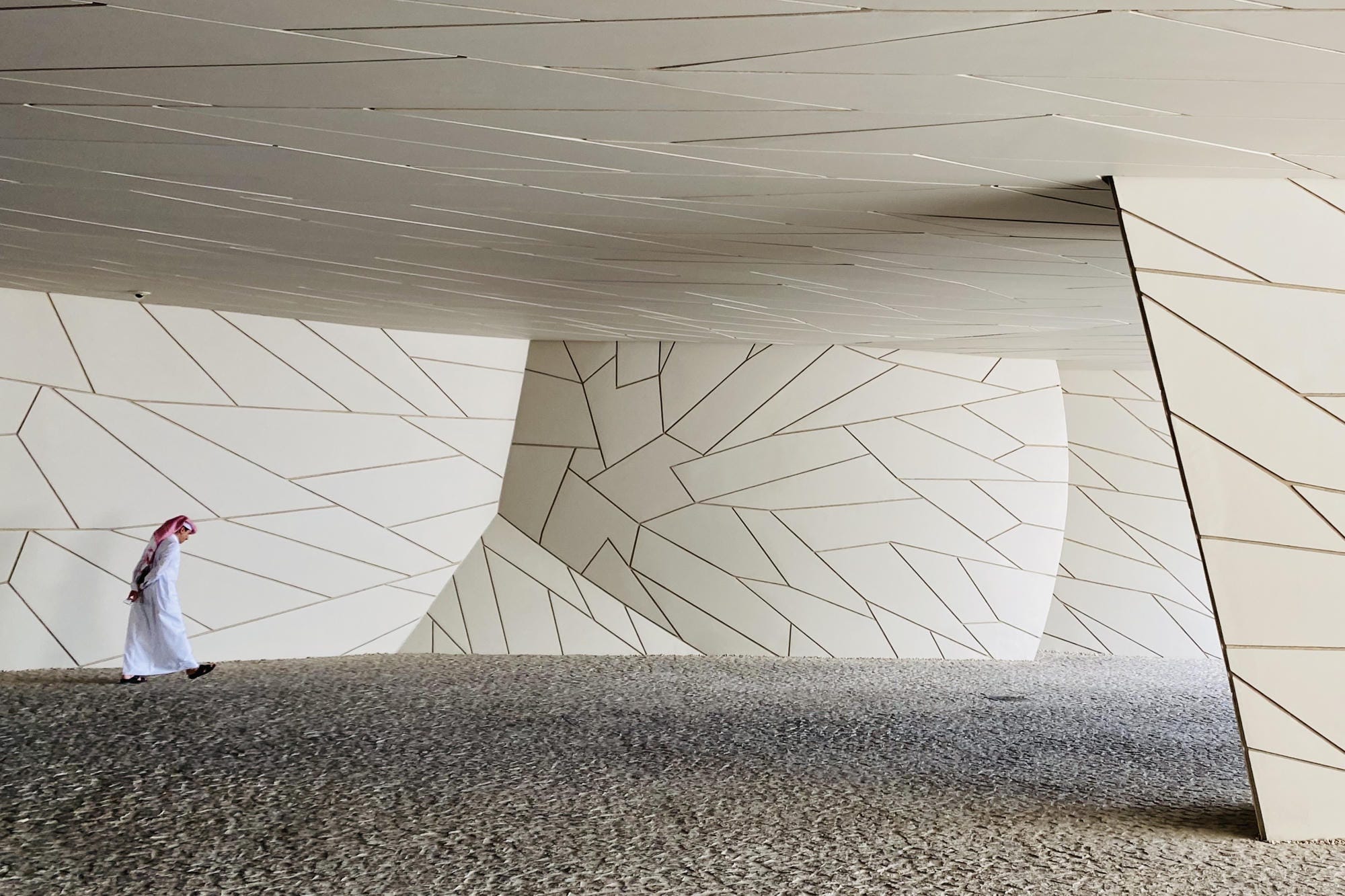
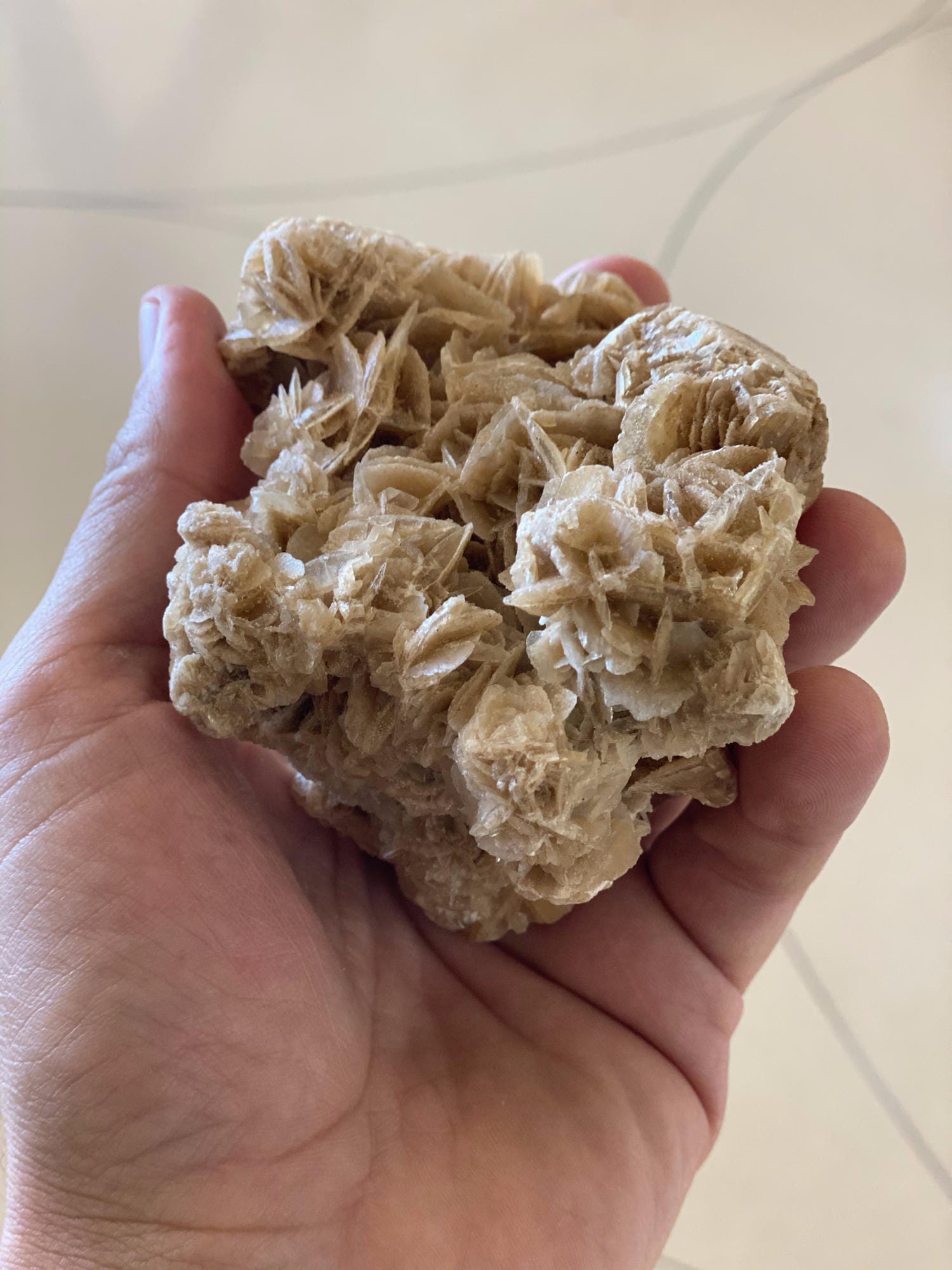
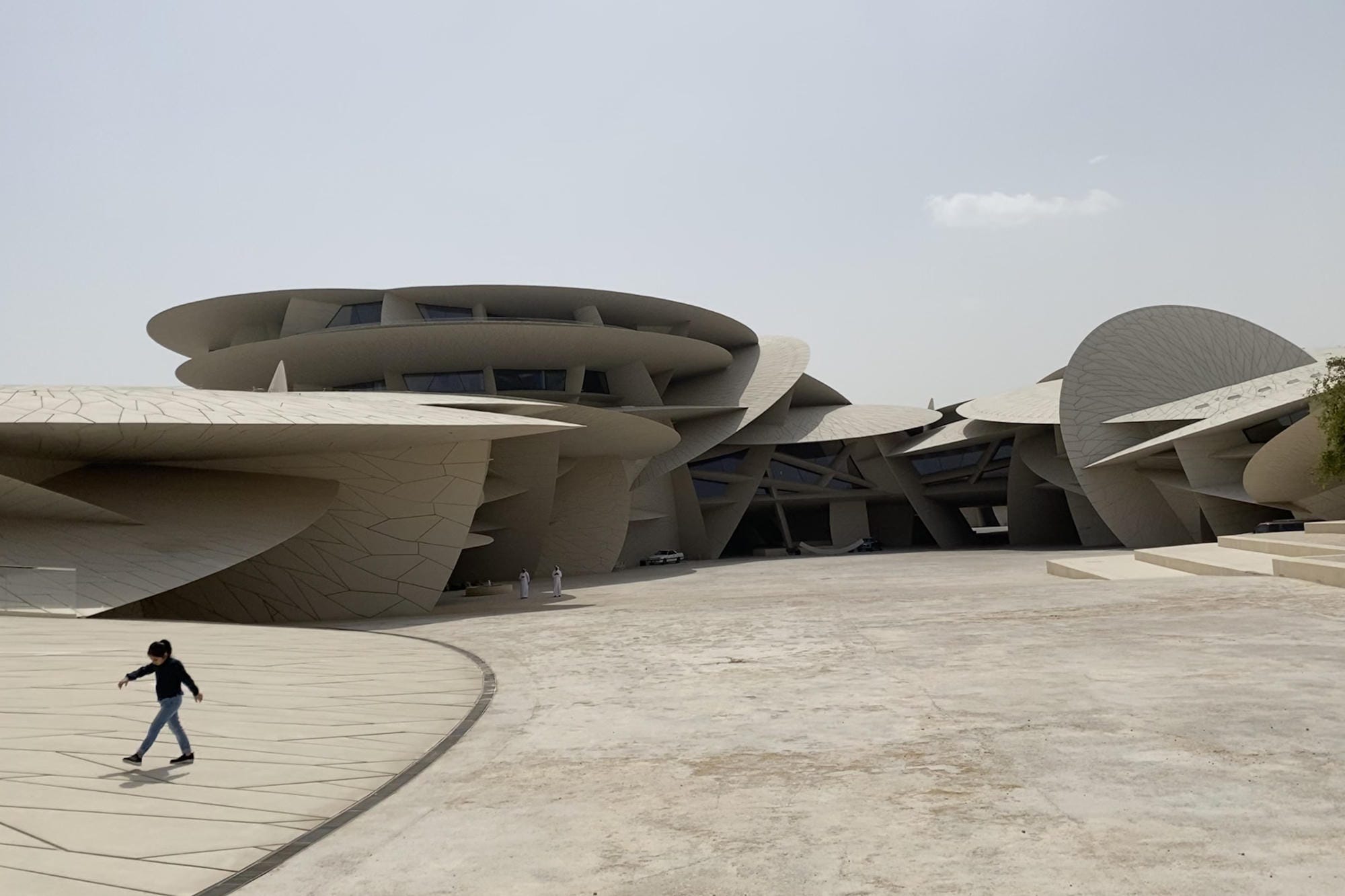
There are buildings that achieve the first two with no apparent effort, and that is why they read like a well-made poem, romantic, precise and deep. The National Museum of Qatar, by Jean Nouvel (2019), is inspired by a desert rose. It is spectacular. It is also exact: the form is not a whim set down on the Gulf, it is a reading of the geology, of the light and of a culture that already had that figure before the architect arrived. Iconic, sculptural and of its place, all at once. Even more successful, more “refined”… or let’s spare the comparison, but it moved me even more: the Louvre Abu Dhabi (Jean Nouvel, 2017), which I have walked through more than once and enjoy more each time. (What is refined? A conversation for another day… a different bar in every context.)
Having visited the city on other occasions and watched it grow, in November 2021 I went to Dubai, as AIA International Country Representative - Argentina, for the institute’s international conference, which coincided with the Expo, and we toured not only Expo buildings but many works in the surrounding area, with their authors or members of their design teams. From there we slipped away one day to Abu Dhabi and visited, among other works, the Louvre with colleagues. Despite many conversations with colleagues from the region and from all over the world, the dome explained itself. The museum’s official version is clear, and it is enough: an Arab dome made of stars, a low medina by the water, and the shade of desert palms translated into a rain of light. A colleague at the conference added another, more romantic layer: that the idea was also to recreate the village where the sheikh who championed the museum had grown up. I couldn’t verify it, and I didn’t need to… since a similar intention is plain to see, to recreate those unique little streets that grew organically in the settlements of the region, if not of the whole Arab world. What is documented is more than enough. The spatial quality is of a rare mastery. The light makes the most of the desert, and the spaces illustrate the culture for us. There is something poetic, and there is something I can only call magical, without embarrassment. At the same time, the building creates a transition between water and land that stitches both worlds together, the history of the desert with that of the Gulf’s merchants and sailors. A building like this does not need to choose between icon and place. It is both because it understood what the site was made of.
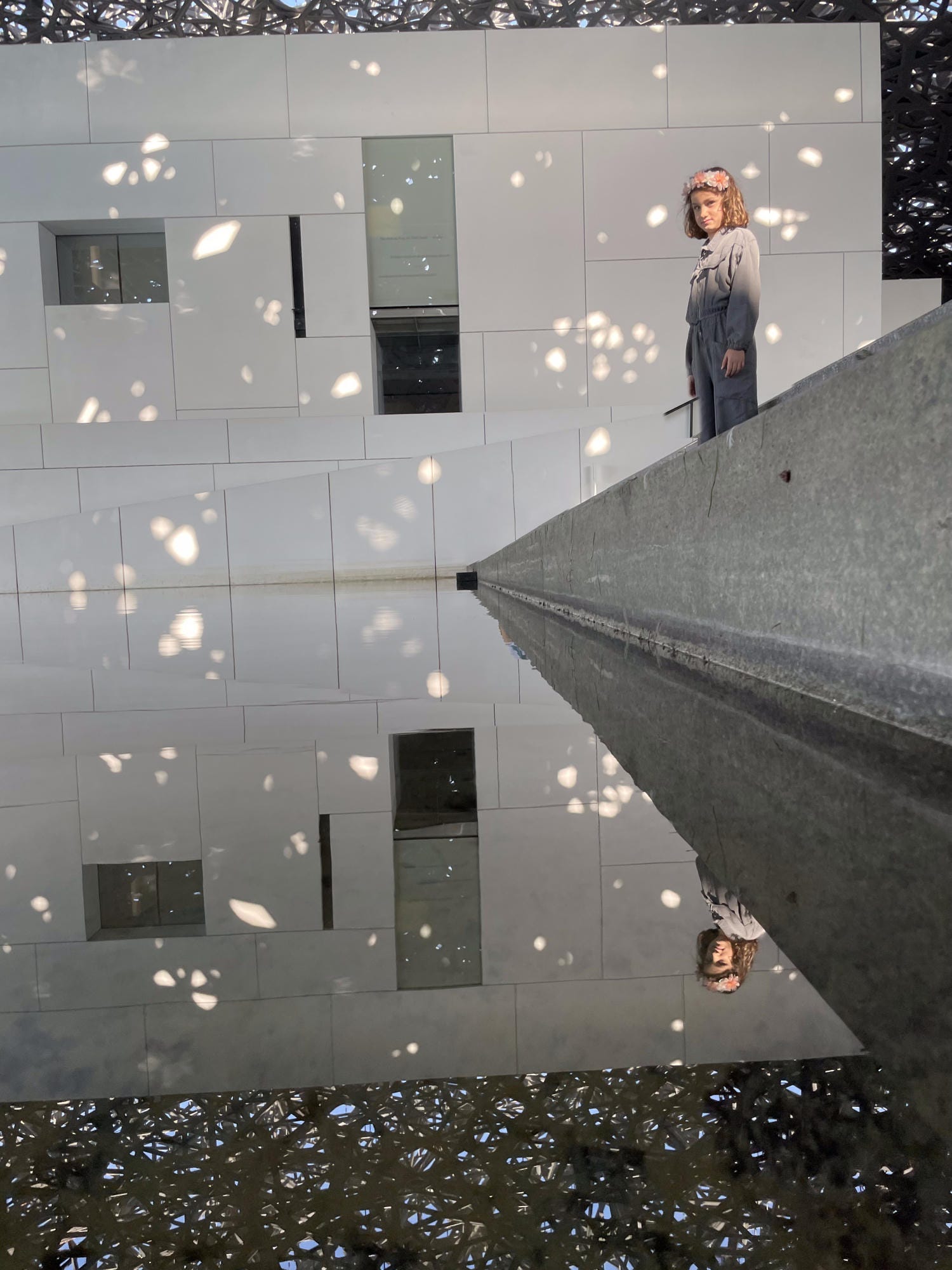
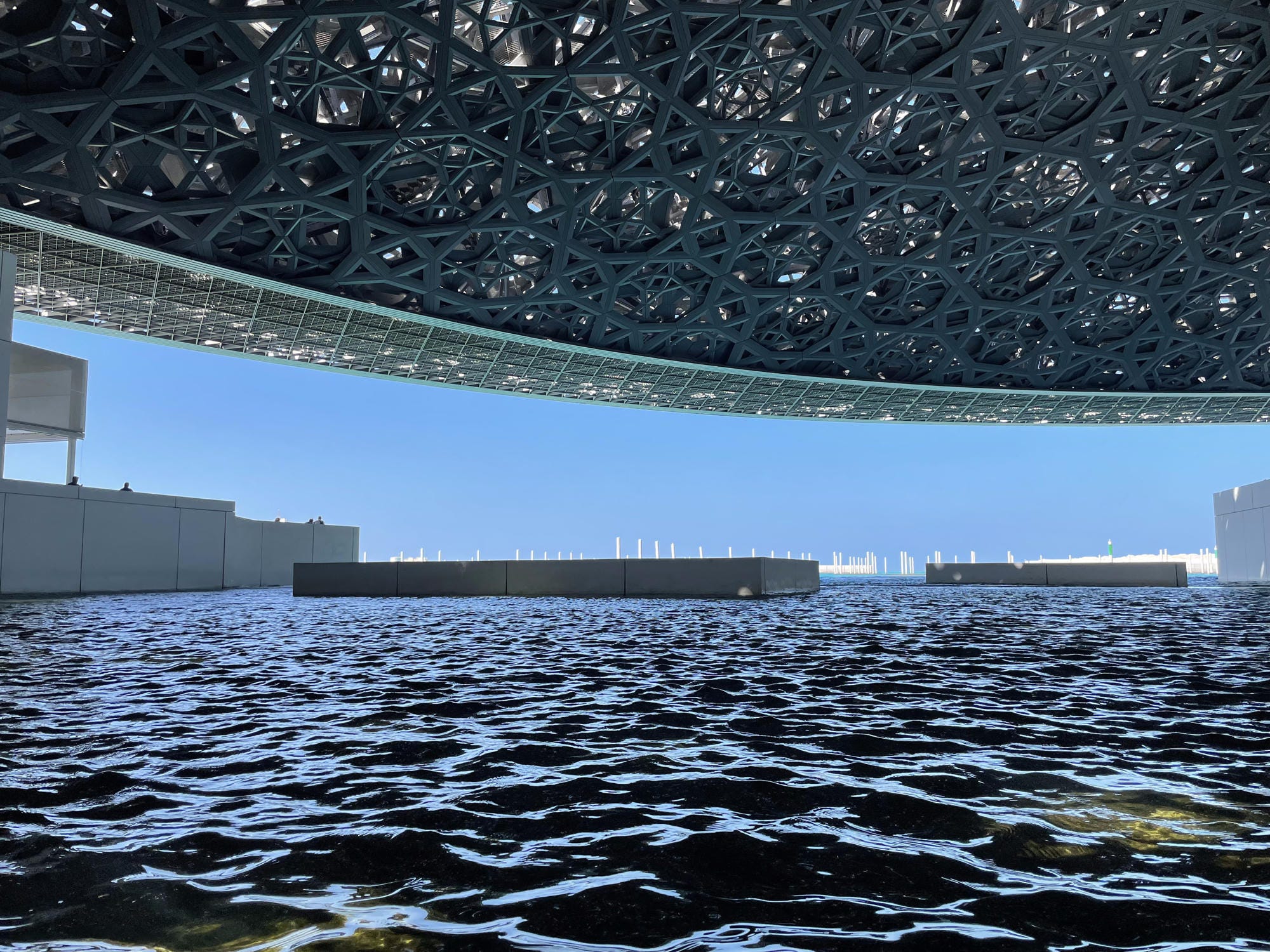
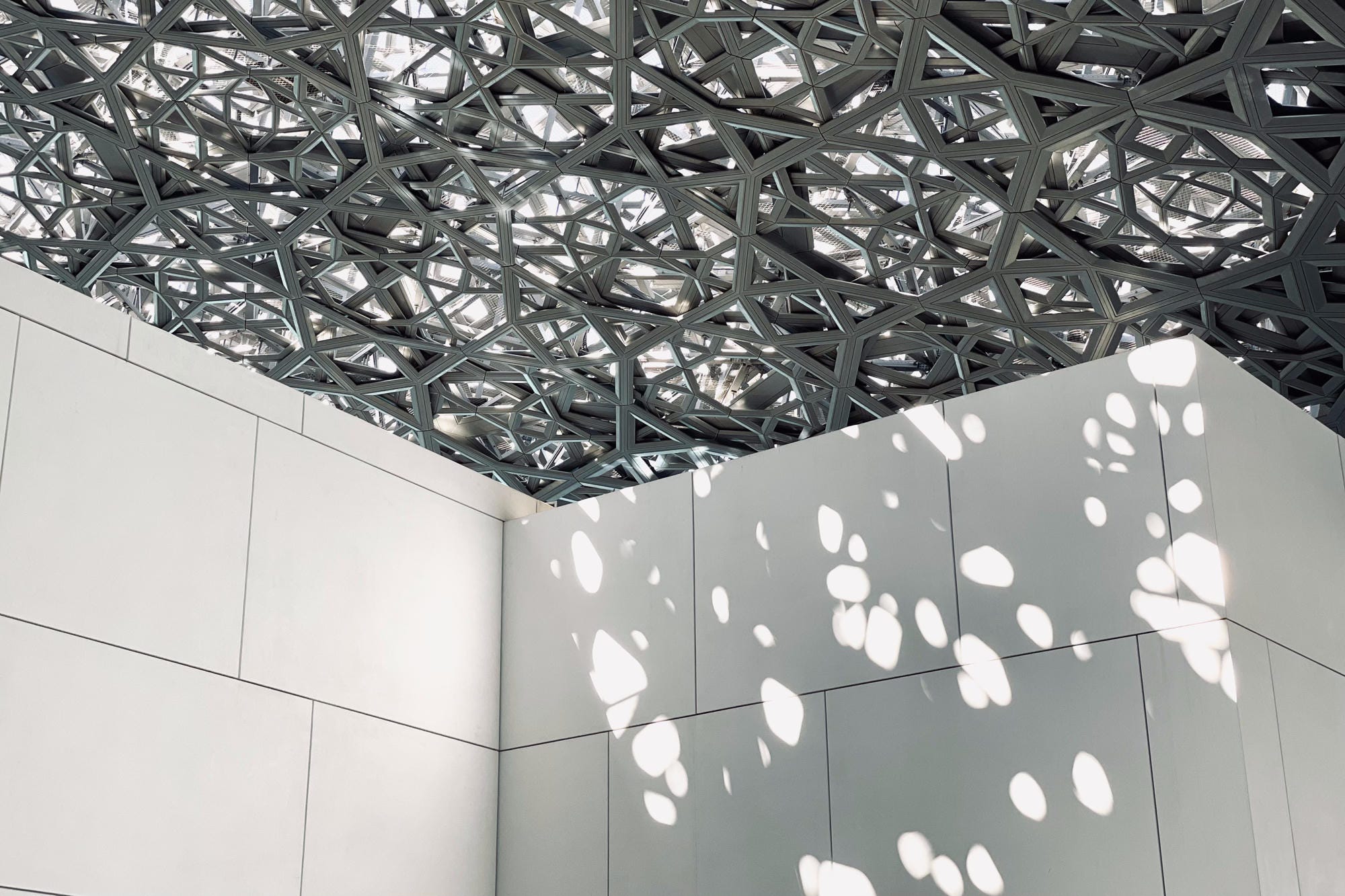
The Lucas doesn’t tell me that. It tells me form. One more contemporary form, skillful, expensive, photogenic, that could stand in another city without losing or gaining much. I don’t read it as a Los Angeles museum. I read it as a museum that landed in Los Angeles. Something similar happened to me with the Museum of the Future (Killa Design, 2022), in Dubai: fascinating to visit, but not very inspiring when I heard its architect tell the story of its genesis at the AIA conference. It sounded like a sum of too many gestures smudging into one another. I will write about Dubai and Abu Dhabi in another piece. I was lucky to watch them grow, from a handful of towers into what I now see, without irony, as a great metropolis. But that is another conversation.
It’s not that the gesture is forbidden. Let’s bring in a classic, for the sheer intellectual pleasure of it: the Guggenheim in New York (Frank Lloyd Wright, 1959) has nothing to do with the city, and it is a masterpiece. The era in which it was made, and how revolutionary its design was, turned it into a landmark as well as a work that left its mark on the whole world. The Centre Pompidou, by Renzo Piano and Richard Rogers (with Gianfranco Franchini, 1977), the same: if someone proposed that building today in a neighborhood like the Marais it would be madness, and yet it became an irreplaceable icon, and a very beautiful one, by the way. I think much of it is that it arrived at the right moment. (And it didn’t intend to tear down the whole Marais, like Le Corbusier’s Plan Voisin of 1925, the one with cruciform towers and airplanes, which thank the gods was never built. In this case it was only a few blocks: an old «îlot insalubre», an unhealthy slum block, demolished in the thirties, which for decades was a parking lot.) I. M. Pei at the Louvre in Paris (1989) is the opposite case, and of course one of exemplary subtlety: a clear piece, almost disrespectful in its announcement, but one that ends up enhancing the palace instead of competing with it. Tate Modern (Herzog & de Meuron, 2000), in London, talks to the river, to the brick, to the power station it once was and to the brick that, block by block, built the city. Richard Meier’s Getty Center (1997), in Los Angeles, carries the author’s mark too visibly, it’s true, but the topography and the views save it: it is a museum from there, not from somewhere else.
Gehry is harder, and I don’t want to keep hitting him out of habit, but… He died on December 5, 2025 and, despite my harsh remarks, I think he was a genius; I admire his brilliant career. His museums carry more personal signature than reading of the place. I believe that direction, the object that travels unchanged to Bilbao, Paris, Los Angeles or Abu Dhabi, was the most visible face of the cultural flattening that came in great waves after international architecture. Not because internationalism was evil, but because it replaced a universalism of rules with a universalism of signature. It is unfair, perhaps, to judge him only with today’s eyes: Gehry was formed in another era, when the gesture could still often be a liberation. But an architect’s quality, his intellectual level, the decision to add value or to open a path that others followed less well, transcends the era. Zumthor is brilliant, for the opposite reason: an architecture of authorship that doesn’t distract, that always leaves something more than a signature. His hand is there, but it doesn’t ask to be applauded, it doesn’t get distracted by being himself, and it stays focused on his projects.
The Guggenheim Bilbao (Frank Gehry, 1997) is the case these weeks keep putting in front of me again, even if the debate already bores my generation… and me. As a dialogue with history it is highly questionable, or it is the lesson of dialogue by contrast, which is not the same as dialogue out of admiration or respect. As an operation it was a commercial success that put Bilbao on the map. Both sentences can be true. When, at some point, I visit Gehry’s Guggenheim in Abu Dhabi (it opens on December 11, next to the magic of Nouvel’s Louvre), I will also go without expectations. Like the ones I had going to the Lucas, which dissolved when I saw it from outside. I think that pair can stand, for anyone who wants to look, as the example of what should be done and what shouldn’t. I hope I’m wrong? I don’t know, but I’m sure I will enjoy it despite the controversy it stirs in me. I never stop greatly admiring those who give me an excuse to reflect, let alone those who manage to build works of this scale and significance.
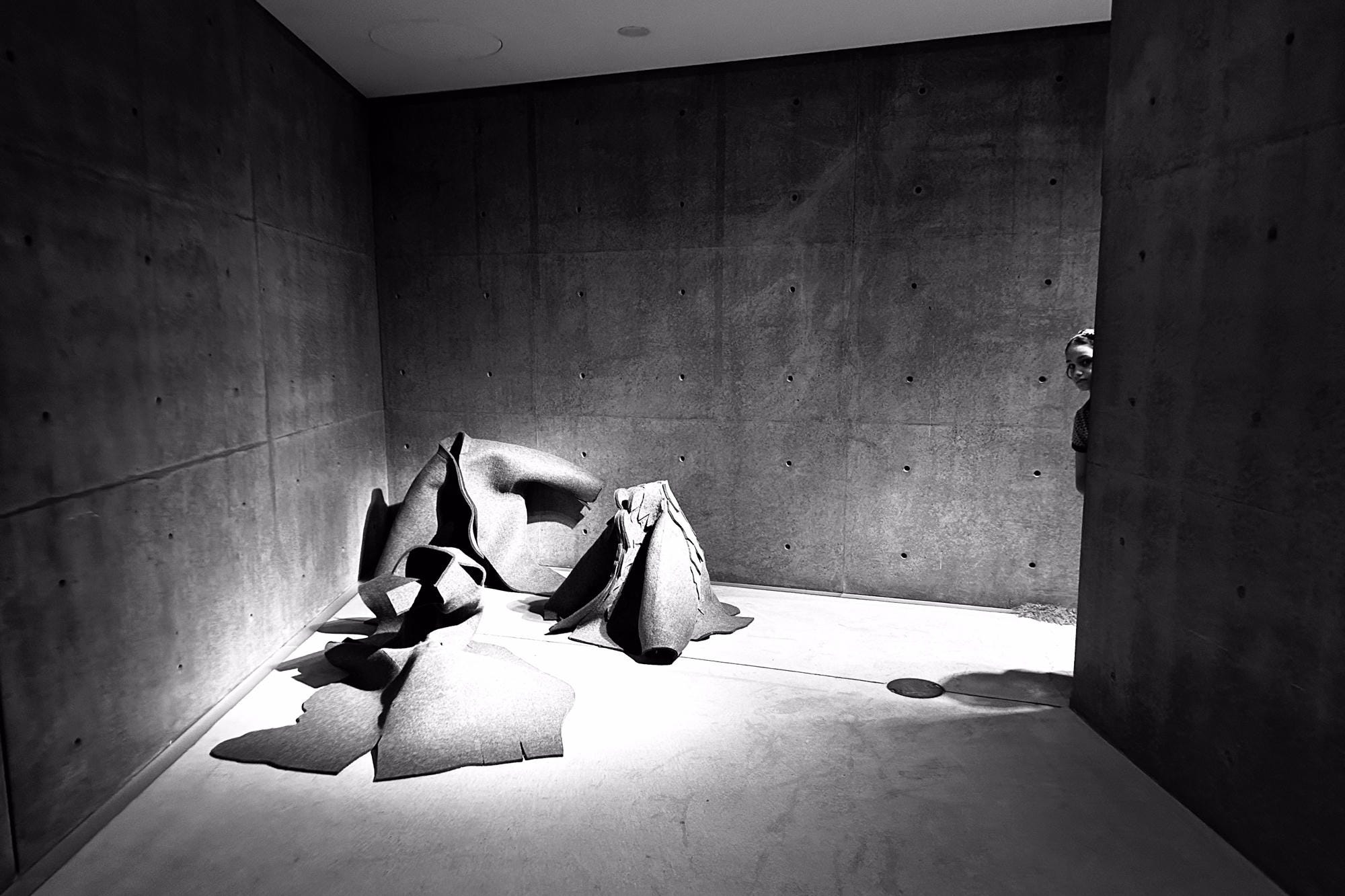
At the other end are the ones that disappear without going mute. The Nezu, by Kengo Kuma (2009), in Tokyo, next to a century-old garden: modern and traditional at once, perhaps the finest of the ones I mention. In the Seto Inland Sea, the water museum by Ryue Nishizawa and the artist Rei Naito (2010), on Teshima: a piece, an icon, a concrete shell that looks like a drop, and at the same time a poetic mastery that is in tune with the island. And Tadao Ando’s on the same islands, the Chichu Art Museum (2004) and the Benesse House Museum (1992): sculptural, iconic, very personal and mysteriously of their place. Buried, oriented, made of the light of that sea. They draw attention by disappearing and are lighthouses at the same time. That, for me, is the successful museum. While we’re in Japan, we can also talk about Tadao Ando’s 21_21 Design Sight (2007), in Tokyo, which sinks into a plaza and creates a spectacular route from an austere entrance that talks to the plaza. And the light, of a well-judged subtlety: low, measured, almost silent, just enough for the concrete and the work to look at each other. My daughter peeked out from behind a wall, on the edge between the shadow and that light, which is exactly where Ando leaves you. In another ancient culture, another example could be the Acropolis Museum (Bernard Tschumi, with Michael Photiadis, 2009), in Athens, which on top of that talks to the ruins beneath it.
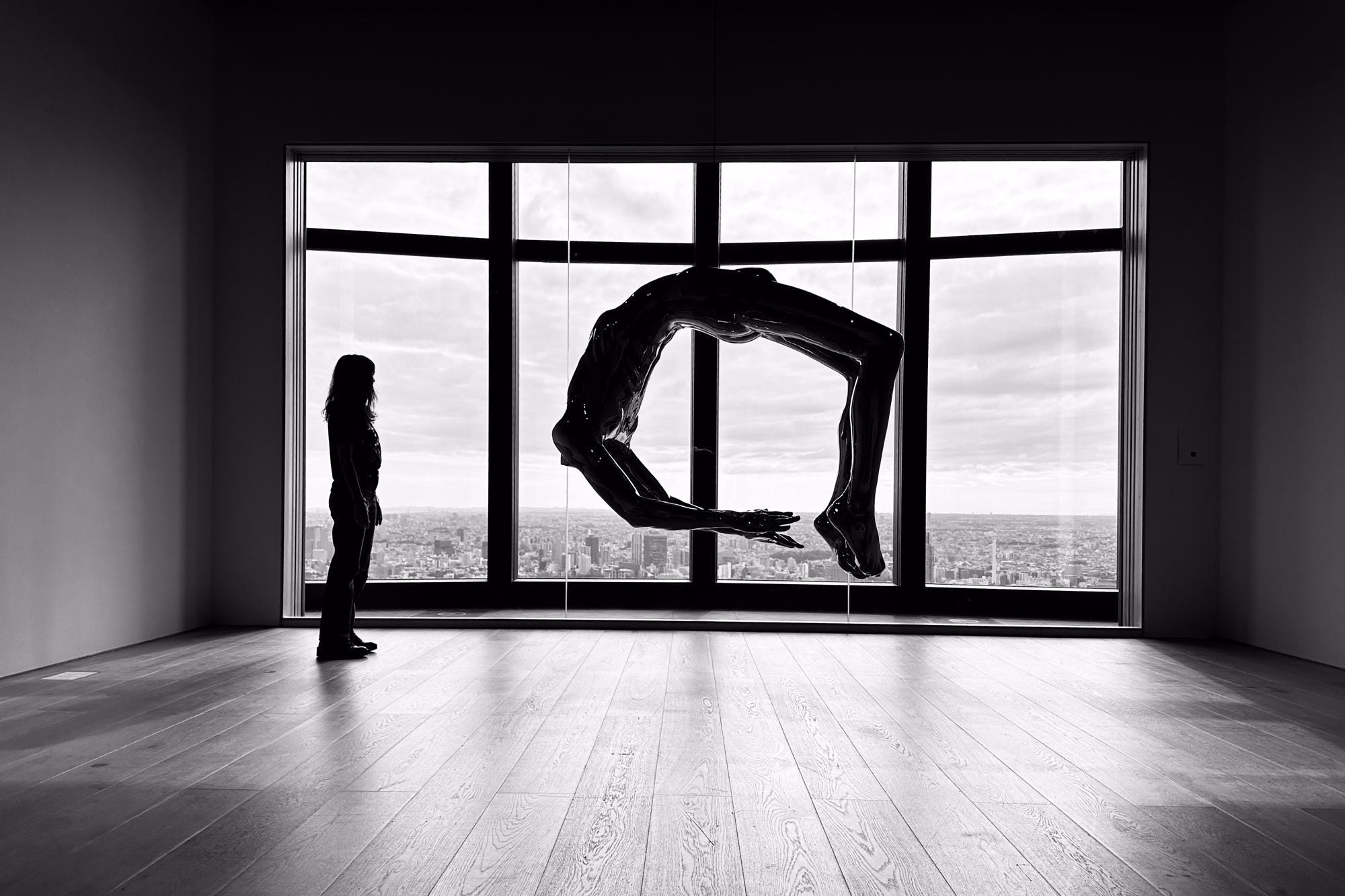
Tokyo also has the case almost nobody mentions when talking about museums: the Mori Art Museum (interiors by Gluckman Mayner, 2003), on the 52nd and 53rd floors of Mori Tower (Kohn Pedersen Fox, 2003). It goes unnoticed. It has no facade of its own: it is one more piece of the great Roppongi Hills master plan (Mori Building, 2003). Up there, at the top of the tower, its only context is the views. A large window frames the whole city, and the work stands cut out against Tokyo. It doesn’t disappear into the place: the place appears through the window.
There is a phrase that has been going around for some years, and which I find dangerous because it is so easy: that any new building that does not put place and culture above drawing attention is in bad taste. Are there exceptions? Always… or there will be… Fortunately there are more and more voices in that direction. The problem is the word. What is taste? Who has good or bad taste? It is a hard subject to explain with any depth if one stays within architecture alone, because taste is usually the elegant name for a group’s agreement. I prefer to speak of getting it right. Getting it right can be argued: material, climate, history, program, light, how you enter, what you see before you see the work. Taste can’t; it is almost… capricious, and “caprice” is, most of the time, a certainty about something misjudged, small in its intention.
A little controversy in my hometown… which is always entertaining: I remember an afternoon at the architecture school in Buenos Aires. One of the executing architects of Malba, the city’s museum of Latin American art, came to present the project (designed by Atelman, Fourcade and Tapia, who won it in a competition in 1997; because the authors were young, and to ensure sound execution, site supervision was left in the hands of an experienced outside firm; even so, winning that competition was a great achievement for such a young studio; 2001). At one point… Shall I spare the name? Someone who went on to have a spectacular career anyway, but I don’t want to get distracted… This architect shared with a certain pride that the stone cladding of a museum of Latin American art had been brought from Germany. I raised my hand. I was a student, and I was, justifiably, a little disrespectful, because I was truly dismayed. I asked him whether a European stone in a Latin American museum had seemed right to him. The whole auditorium made that sound, the «oooh», the one people make when someone says something you don’t say. That reaction marked me more than the answer. I even saw two of my professors turn and look at me, proud that I had said something they surely thought but that it wouldn’t have been proper for them to say to a guest… That’s the way, I thought… You have to ask, and you have to say what you think, whether you’re a student or already formed. Never stop questioning ourselves and provoking reflection.
It wasn’t a whim about origin. It was a question of meaning. A museum of Latin American art that dresses itself in stone from another continent is saying, before hanging the first work, that what we had here wasn’t enough. That we are still copying whatever arrived in so many waves of ships? One can argue the technical detail (durability, quarry, maintenance) and I will still think the decision was a resounding misjudgment. Material is a building’s first text.
Another criticism I have had stuck in my throat for years: why do the main circulation, the stairs and the first-floor terrace face just another Buenos Aires street, 17.32 m wide (≈ 20 varas, the old Spanish unit behind the standard width of the city’s street grid), and not the plaza? And why is the facade toward the plaza entirely (70%?) taken up by a part of the program that needs to be closed, the auditorium, which makes no use of it? Although it is an interesting piece of interlocking volumes that talks to the urban fabric, Malba is a bad project; but it is true that it did the city a lot of good, and its patron’s initiatives and contributions to culture are truly excellent, so as not to stop at negative criticism…
That’s why I look with interest at what Malba announced this very season: doubling its exhibition space beneath Plaza Perú, with a project by Frida Escobedo (in design, opening expected for late 2029 or early 2030), without shrinking the plaza or closing it to the public. It isn’t Zumthor, and it doesn’t need to be. It is the other strategy, the one that best serves a city with few plazas and a fabric that already exists: don’t build a monument next door, grow underneath (without cost overruns?), stitch the museum to the plaza instead of competing with it. (If anyone wants to, let them look into the fact that there was a buried project in Malba’s original competition.) In Latin America the temptation of the icon is strong, because the icon promises the Bilbao effect with a single photo. It almost never arrives. What does arrive, and can be paid for, is the piece that reads the place, even if it is small, even if it disappears a little.
Fragmenting or monumentalizing is not a morality. It is a strategy. Zumthor fragments because the Riehen park was already the protagonist, and because Piano had set a low, long bar. MAD monumentalizes because the commission was a “billion-dollar” foundation and a collection that wants to exist on the map before anyone walks in. Both can be honest with their client. Only one seems to me honest with the city. And the city, in the end, is the one left with the building once the opening is over.
For me, talking about museums is a thrilling subject: a very complete and profound modern program. It is also the best one I know for a life of travel: walking through them, and through their shops, which say almost as much as the galleries. This is my second piece on Pathos. Here is a question: whether a building owes something to its place, or whether it is enough to be memorable. I believe the “museum” program carries a responsibility: it owes the site an answer. And I believe the ones that achieve both (Nouvel in the desert, Kuma by the garden, Nishizawa and Ando on the Seto Inland Sea, Pei in the courtyard of a palace) are not the romantic exception. They are the bar.
Here are some of the sites and sources I consulted while writing this piece, for anyone who wants a closer look:
Sources
Fondation Beyeler, Peter Zumthor’s expansion (official site): https://www.fondationbeyeler.ch/en · Designboom, “Peter Zumthor’s expanded Fondation Beyeler opens to the public”: https://www.designboom.com/architecture/peter-zumthor-fondation-beyeler-gradual-opening-basel-switzerland-wyss-museum/ · The Art Newspaper, “Switzerland’s Fondation Beyeler opens £109.7m expansion”: https://www.theartnewspaper.com/2026/09/25/fondation-beyeler-basel-switzerland-peter-zumthor-expansion · ArchDaily, “Fondation Beyeler to Open Expanded Campus by Peter Zumthor in 2027”: https://www.archdaily.com/1042400/fondation-beyeler-to-open-expanded-campus-by-peter-zumthor-in-2027
Lucas Museum of Narrative Art, opening (official site): https://lucasmuseum.org/ · Opening press release: https://lucasmuseum.org/press/grand-opening · The Art Newspaper, “$1bn Lucas Museum of Narrative Art lifts off at long last”: https://www.theartnewspaper.com/2026/09/07/lucas-museum-narrative-art-opening-preview-los-angeles · Designboom, “MAD’s Lucas Museum of Narrative Art opens in Los Angeles”: https://www.designboom.com/architecture/mad-lucas-museum-narrative-art-early-look-inside/ · Architectural Record: https://www.architecturalrecord.com/articles/18401-the-lucas-museum-set-for-september-22-opening · CNN: https://www.cnn.com/2026/09/05/style/lucas-museum-of-narrative-art-opening
LACMA, David Geffen Galleries, Peter Zumthor (official site): https://www.lacma.org/press/lacmas-new-david-geffen-galleries-designed-peter-zumthor-open-april-19 · SOM, “SOM and Atelier Peter Zumthor Complete David Geffen Galleries at LACMA”: https://www.som.com/news/lacma-opens/
MAD Architects: https://www.i-mad.com · Atelier Peter Zumthor: https://www.peterzumthor.com
Louvre Abu Dhabi, Jean Nouvel’s architecture (rain of light, medina, dome): https://www.louvreabudhabi.ae/en/about-us/architecture
National Museum of Qatar, Jean Nouvel, desert rose: https://nmoq.org.qa
Museum of the Future, Dubai: https://museumofthefuture.ae
Guggenheim New York, Frank Lloyd Wright: https://www.guggenheim.org/the-frank-lloyd-wright-building · Guggenheim Bilbao: https://www.guggenheim-bilbao.eus · Guggenheim Abu Dhabi, Frank Gehry: https://www.guggenheimabudhabi.ae
Louvre Paris, pyramid by I. M. Pei: https://www.louvre.fr/en/explore/the-palace/a-pyramid-for-a-symbol · Centre Pompidou: https://www.centrepompidou.fr · Plan Voisin, Le Corbusier (Fondation Le Corbusier): https://www.fondationlecorbusier.fr/en/work-architecture/projects-plan-voisin-france-1925/
Tate Modern, Herzog & de Meuron on the Bankside Power Station: https://www.tate.org.uk/visit/tate-modern
Getty Center, Richard Meier: https://www.getty.edu/visit/center/ · Acropolis Museum, Bernard Tschumi: https://www.theacropolismuseum.gr/en/museum-building
Nezu Museum, Kengo Kuma: https://www.nezu-muse.or.jp/en/ · Teshima Art Museum, Ryue Nishizawa and Rei Naito: https://benesse-artsite.jp/en/art/teshima-artmuseum.html · Chichu Art Museum, Tadao Ando, Naoshima: https://benesse-artsite.jp/en/art/chichu.html · Benesse House Museum, Tadao Ando, Naoshima: https://benesse-artsite.jp/en/art/benessehouse-museum.html · 21_21 Design Sight, Tadao Ando: https://www.2121designsight.jp/en/ · Mori Art Museum, Roppongi Hills: https://www.mori.art.museum/en/ · Roppongi Hills, Mori Building: https://www.mori.co.jp/en/projects/roppongihills/
Malba, expansion beneath Plaza Perú, Frida Escobedo: The Art Newspaper, “Malba picks architect for expansion that will double its exhibition space”: https://www.theartnewspaper.com/2026/09/17/malba-museum-buenos-aires-frida-escobedo-architect-expansion · Perfil: https://www.perfil.com/noticias/cultura/malba-cumple-25-anos-y-anuncia-una-ampliacion-una-megadonacion-y-un-fondo-de-us50-millones.phtml · Malba: https://www.malba.org.ar
Pathos 01, for readers arriving through this piece: https://www.pathospractice.com/p/pathos-01-is-there-an-argentine-school